
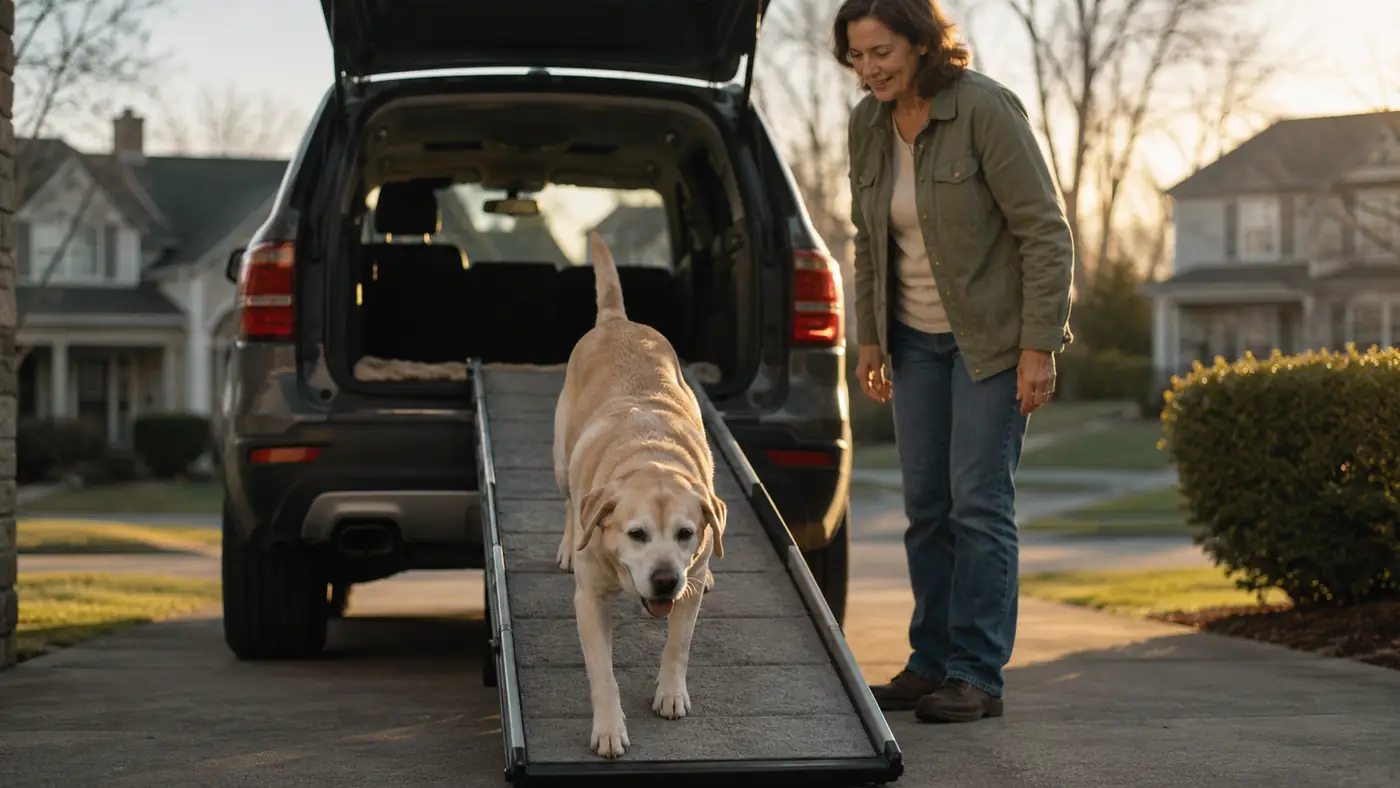
My husband and I have loaded a lot of dogs into the back of an SUV over fifteen years of fostering, but nothing tested my patience like watching my eleven-year-old yellow Lab, Duke, hesitate at the tailgate every single morning. He used to launch himself into the cargo area without a second thought. Then last spring his hips started telling on him, and by June he'd just stand there and look up at me like the truck had grown three feet taller overnight. That's what pushed me to finally order the PetSafe Happy Ride Folding Pet Ramp, and six months later I can tell you exactly where it earns its keep and where it falls short.
Duke is 74 pounds, diagnosed with mild hip dysplasia in his left leg back in April, and he rides with us almost daily to the vet clinic where I volunteer, to the lake, or just around Franklin County running errands. We also have Ranger, a five-year-old mixed breed who has zero interest in ramps and still jumps, and Biscuit, our senior cat, who wants nothing to do with any of this. This review is specifically about what the Happy Ride did for a dog who genuinely needed the help, not a young, healthy dog who could take it or leave it.
The Quick Verdict
Solid, honestly priced ramp that solved our loading problem within two weeks, but the fold hinge shows wear and the angle is steeper than PetSafe's marketing photos suggest on a taller SUV.
Amazon Check Today's Price →Stop lifting a dog who doesn't want to be lifted.
If your dog hesitates, whines, or refuses at the tailgate the way Duke did, a ramp with real non-slip tread changes the entire routine, not just the injury.
Amazon Check Today's Price on Amazon →How I've Used It
We use the ramp against a 2019 Toyota Highlander with the tailgate raised, which puts the top edge somewhere around 30 inches off the ground. The Happy Ride is rated for that range and unfolds to 62 inches, so the angle ends up a little steeper than the smiling golden retriever in PetSafe's own product photos would suggest, but it's manageable for a dog Duke's size once he trusts it.
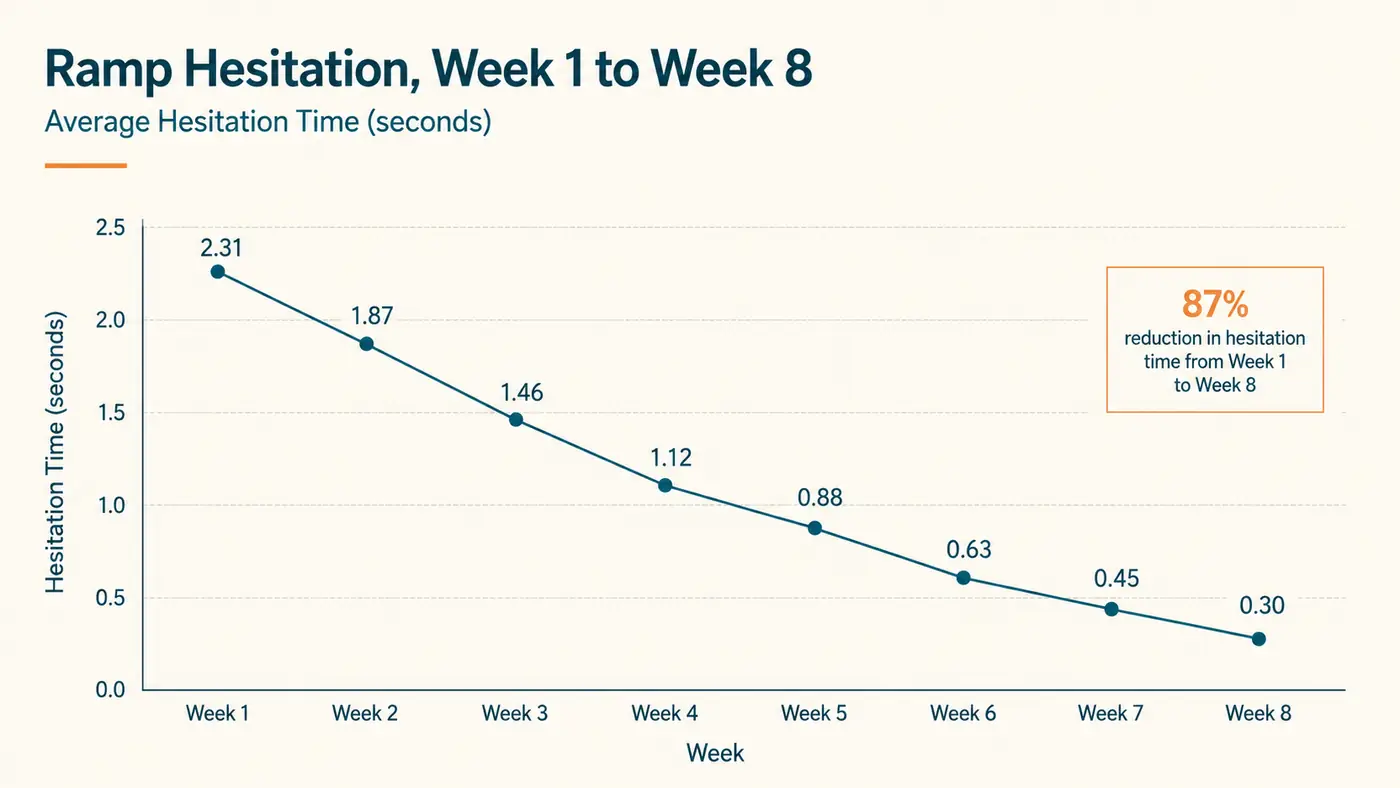
The first week was rough. Duke stood at the bottom sniffing it for what felt like ten minutes some mornings while I was already running late for a vet shift. I didn't force him. I put a piece of string cheese at the top edge of the tread, stood next to him, and let him work it out on his own time. By day nine he was walking up without hesitation about half the time, and by day sixteen it was closer to every time.
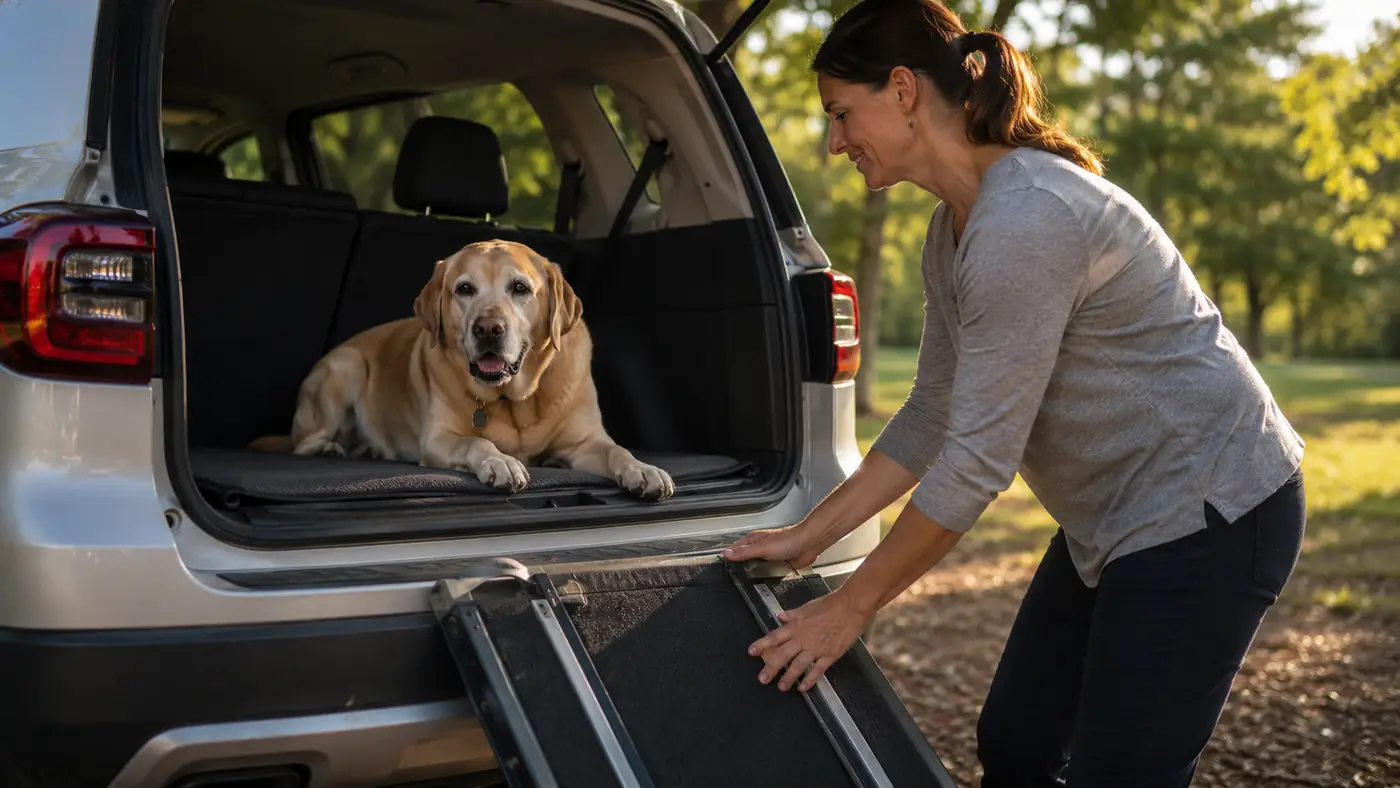
Since then it's been part of the daily routine, folded flat and stored against the wall in the garage between uses. I unfold it, lock the center hinge, hook the top lip over the tailgate lip, and Duke walks up. The whole process from garage to loaded dog takes maybe ninety seconds now, which is faster than trying to boost 74 pounds of stiff Lab into a cargo area ever was.
Setup out of the box took me about five minutes, mostly reading the little hook diagram twice to make sure I had the tailgate lip oriented the right way. There's no assembly beyond unfolding it and locking the hinge pin. I appreciated that, honestly, because I've dealt with pet gear that needed a screwdriver and a spare thirty minutes before it could do its one job, and this wasn't that.
The Tread, the Fold, and What PetSafe Got Right
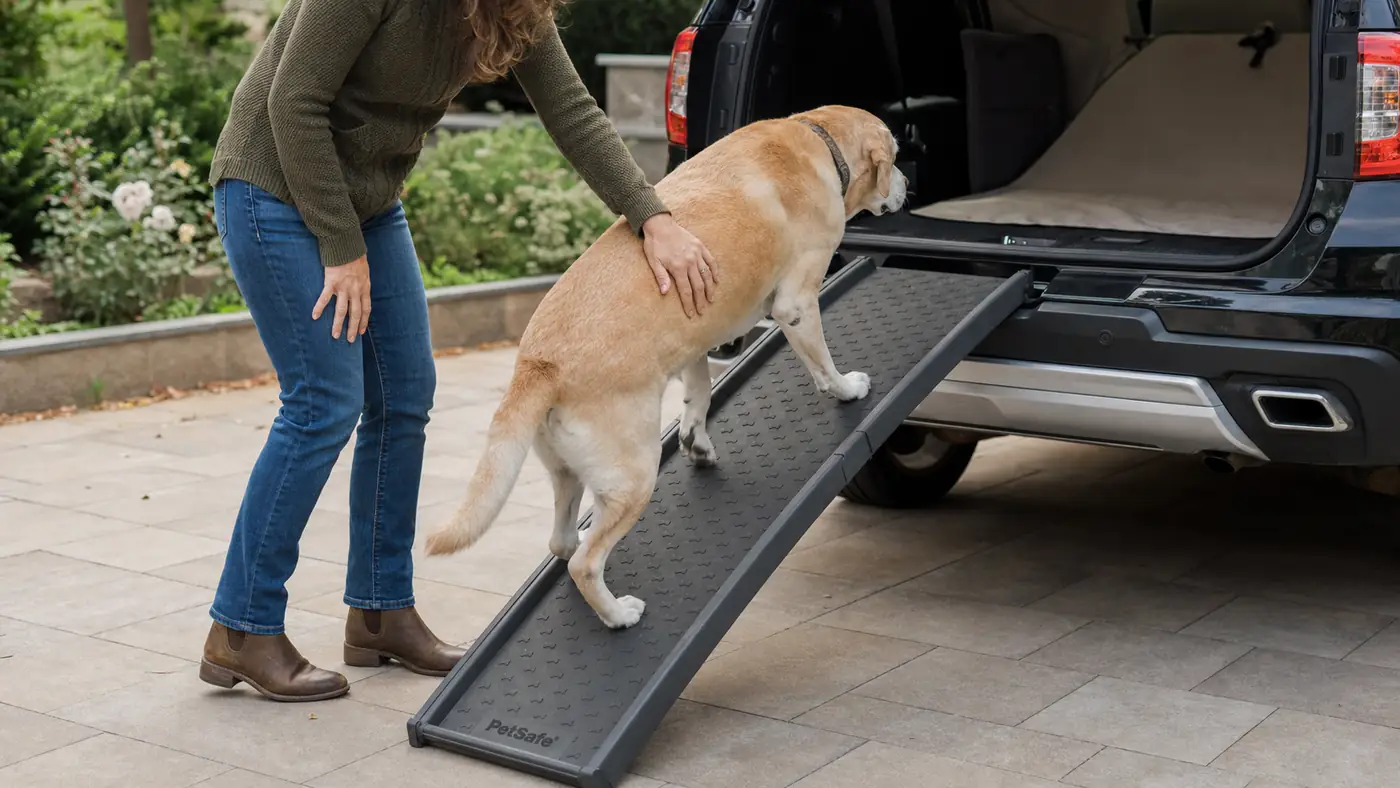
The tread is the reason this ramp earned its spot in our garage instead of getting returned. It's a textured, carpet-like surface bonded to the aluminum frame rather than a smooth plastic panel, and even after Duke has walked up it wet from the sprinkler or muddy from the yard, I haven't seen him slip. That matters more than any other single feature on a ramp built for a dog with joint issues, because a slip is exactly the thing that turns a helpful tool into a dog who refuses to ever use it again.
PetSafe built in raised side rails along both edges, low ones, maybe three-quarters of an inch, but enough that Duke's back feet have caught the edge and corrected instead of sliding off twice in six months. It folds in half at a center hinge for storage, down to about 31 inches, and at just under 11 pounds I can carry it one-handed from the garage to the driveway without straining anything.
The weight rating on this model tops out at 400 pounds distributed, which is more than generous for a single Lab and would comfortably handle two smaller dogs crossing together, which occasionally happens when I'm fostering and loading two at once for a shelter transport run.
Cleaning it has been simple, which matters more than people expect. I hose it off in the driveway when it's been muddy, or wipe it down with a towel after a wet trail day, and the tread dries fast enough that I'm not tempted to skip it and let mud dry into the fibers. A ramp that's a hassle to clean is a ramp that stops getting used, and this one hasn't given me a reason to avoid it.
Six Months of Daily Loading, What Changed
The biggest shift wasn't the ramp itself, it was Duke. Confidence built slowly and then all at once. Weeks one and two he hesitated most mornings. By week four he'd walk up without any coaxing as long as I was standing nearby. By week eight, hesitation was rare enough that I stopped tracking it in the little notebook I keep for the foster dogs and just started using it out of habit for him too.
The tread has held up better than I expected given how often it's outside in Ohio weather. We've had it out in light rain, frost in January, and one memorably muddy March. The surface has some visible wear in the center strip where paws land most often, but it hasn't torn or peeled up at the edges, which is the failure mode I'd braced myself for after reading a few complaints online before buying.
Where I have noticed wear is the center hinge. It folds and unfolds daily, sometimes twice a day, and there's a bit more play in it now than there was in month one. It still locks and holds Duke's weight without any give underfoot, but I can hear a slightly looser click than the tight snap it had out of the box. I'll be watching that closely over the next six months.
Who I'd Point Toward This Specific Ramp
This ramp makes the most sense for mid-to-large dogs, 40 to 90 pounds roughly, loading into an SUV, minivan, or truck bed with a tailgate height under about 32 inches. That's the range where the 62-inch length keeps the incline gentle enough for a dog with hip or knee issues to manage without scrambling.
It's also a smart pick for anyone dealing with a dog who's recovering from surgery rather than dealing with a permanent condition. Several of the fosters that come through our house are post-spay or post-orthopedic-repair, and a ramp we can wipe down and hand off with the dog to their new family has been genuinely useful, not just for us but for whoever adopts them next.
It's also earned a spot in our transport rotation. When I'm driving a batch of shelter dogs to a partner rescue two hours away, having one ramp that works across whichever vehicle I end up borrowing that week, my Highlander, my sister's Suburban, or the rescue's cargo van, has saved me from three separate lifting injuries I probably would have given myself otherwise.
Where It Falls Short
The angle is my biggest complaint. On our Highlander it works, but I borrowed my sister's Suburban for a weekend trip and the taller tailgate height pushed the incline noticeably steeper. Duke managed it, but I wouldn't want to ask an arthritic 90-pound dog to climb that angle daily. If your vehicle sits taller than a standard SUV, measure first.
Storage is the other real tradeoff. Even folded in half at 31 inches, it's a bulky, awkward shape to fit in a trunk that's already loaded with a crate, water bowls, and a foster dog's belongings. We keep ours at home and use it mostly for the SUV in the driveway rather than throwing it in the car for every outing, which limits how much I can lean on it when we're traveling.
And that hinge wear I mentioned earlier is worth flagging honestly. It hasn't failed, but six months of daily folding has loosened it slightly, and I'd guess a household using it multiple times a day for a couple of years might eventually need to replace it rather than expect it to outlast the dog it was bought for.
I'd also mention that today's price puts it firmly in the mid-range for folding ramps, not the cheapest option on the shelf and not the priciest. Given how much daily use it's absorbed without a real failure, I think it's earned that middle spot, but I wouldn't call it a steal, and I'd check current pricing before assuming it's the budget pick in its category.
What I Considered Instead
Before ordering the Happy Ride, I looked hard at telescoping ramps that collapse down to a shorter length for trunk storage. They're more compact, which appealed to me given our packed SUV, but the reviews I read repeatedly mentioned a narrower tread and a wobblier center seam where the sections slide together, which felt like a bad tradeoff for a dog who already didn't trust the process.
I also thought about just building a set of carpeted wooden stairs for the tailgate, which some of my foster network has done. That works fine for a fixed vehicle height, but we regularly switch between the Highlander and borrowed vehicles for transport runs, and a folding ramp travels between vehicles far more easily than a set of stairs sized to one specific tailgate.
One more thing I weighed was a bi-fold ramp with a solid underside versus this one's slightly more open frame. The solid-bottom versions I compared felt sturdier standing on their own, but they also weighed noticeably more, and at 74 pounds Duke doesn't need a ramp rated for a Great Dane. For our situation, lighter and easier to carry daily won out over marginally more rigid.
What I Liked
- Textured non-slip tread held up through mud, rain, and frost without any slipping
- Folds to 31 inches and carries one-handed at just under 11 pounds
- 400-pound weight rating handles a large dog or two smaller dogs together
- Low side rails caught two near-slips off the edge
- Duke went from daily hesitation to walking up without coaxing in about eight weeks
- No tools or assembly required out of the box
Where It Falls Short
- Incline gets noticeably steeper on taller vehicles like a Suburban
- Center hinge has developed slightly more play after six months of daily folding
- Still bulky enough that we don't pack it for every outing
- Takes real patience and a couple of weeks of training before a nervous dog trusts it
Duke didn't learn to trust the ramp because I asked him to. He learned because I stood at the bottom the first dozen mornings and made the whole thing boring.
Who This Is For
If you have a mid-to-large dog with joint pain, a recent surgery, or just the slow stiffness that comes with age, and your vehicle's tailgate sits at a normal SUV or minivan height, this ramp will likely earn its keep the way it did for Duke and me. It's also a reasonable pick for a multi-dog or foster household that needs something durable enough to hand off between animals without babying it, and for anyone who wants a ramp they can teach a nervous dog to trust over a couple of weeks rather than force on day one.
Who Should Skip It
If your vehicle sits unusually tall, if you need something that folds small enough to live permanently in a packed trunk, or if your dog is under 20 pounds and can be carried without strain, you'll likely be happier with a lighter, more compact ramp or a set of pet stairs built for that shorter climb. Owners who need a ramp for daily travel in and out of a small hatchback trunk should also measure the folded dimensions carefully before buying.
Six months in, it's still the first thing I grab before a vet run.
Duke doesn't hesitate at the tailgate anymore, and that alone was worth the price of admission for us. See current availability and pricing before you decide.
Amazon Check Today's Price on Amazon →