
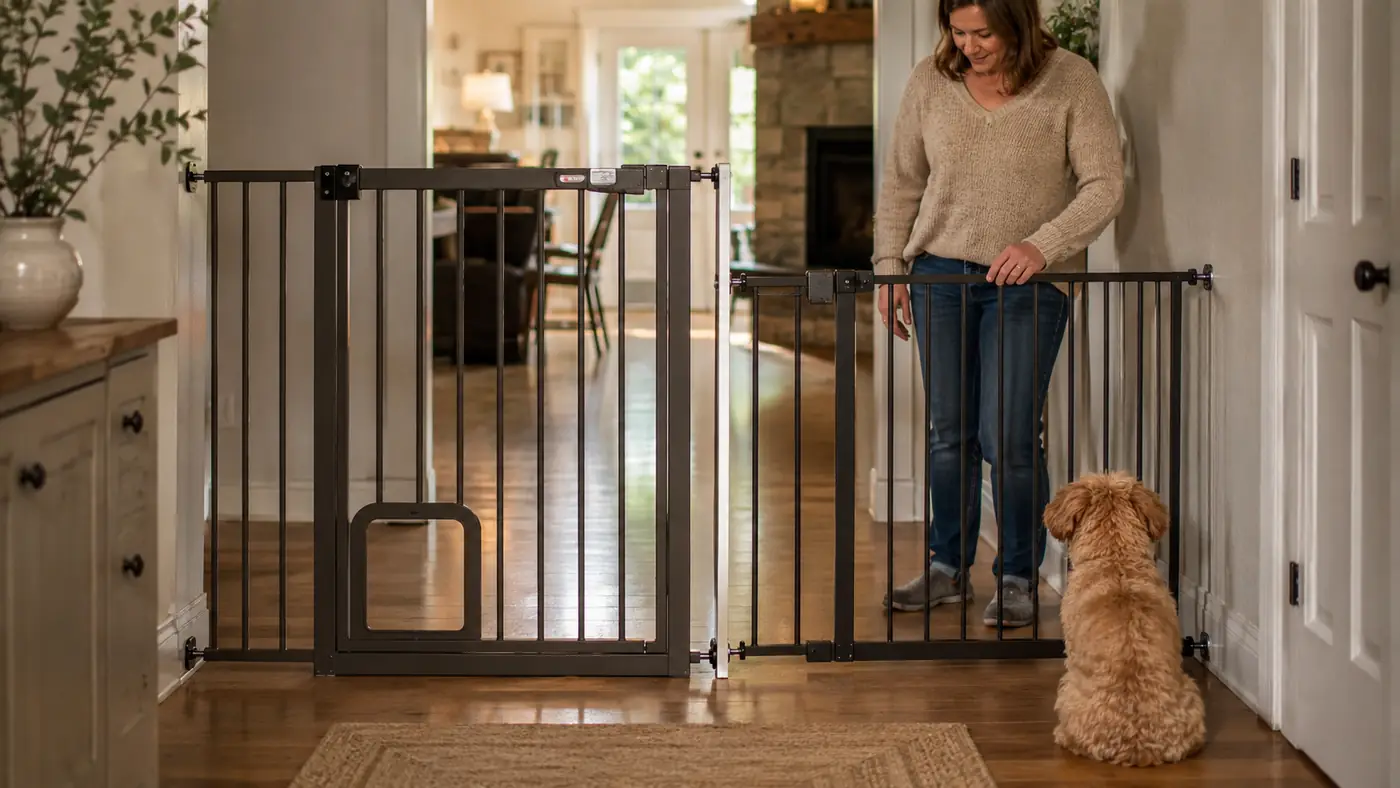
Short answer: if you've got a doorway wider than 32 inches, more than one pet with different access needs, or you're tired of stepping over a gate fifteen times a day, get the Carlson Extra Wide Walk-Through Gate. If you just need a cheap barrier for a narrow hallway that one dog will occasionally test, a standard pressure-mount gate will do the job for less money.
That's the whole verdict. Everything below is why I landed there, after running both styles through actual doorways in my actual house. I've fostered rescues for fifteen years out of a place in Ohio with two dogs and a fifteen-year-old cat named Biscuit who does not appreciate being cornered by anyone, canine or human. Carlson is the brand I keep buying because it's the one gate style that's still functional after a year of being leaned on, walked through, and occasionally used as a chew toy by whichever foster is currently teething. Generic pressure-mount gates have their place, but they are not built for the same kind of daily abuse, and I've replaced enough of them to know the difference isn't marketing, it's the frame and the hardware underneath the paint.
| Carlson Extra Wide Walk-Through Gate | Standard Pressure-Mount Gate | |
|---|---|---|
| Width range | 29.5 to 36.5 inches, extends to fit wide doorways and openings | Typically 26 to 34 inches, narrower fit range on most generic models |
| Access style | Built-in walk-through door with two-way swinging latch, plus a small pet door cutout | No walk-through door, you step over or unmount the whole gate |
| Frame material | Powder-coated steel tube frame | Mix of thinner steel, aluminum, or plastic-reinforced bars depending on brand |
| Installation | Pressure-mounted with wall cups, about 10 to 15 minutes, no drilling required | Pressure-mounted with wall cups, about 5 to 10 minutes, no drilling required |
| Small pet passage | Yes, a dedicated small pet door built into the bottom corner for cats | No, the whole gate blocks smaller pets unless you remove it |
| Stability under weight | Rated for large dogs leaning or pushing, minimal flex at full extension | Noticeable flex or bow at wider extensions, especially with a leaning dog |
| Best for | Multi-pet households, wide doorways, daily walk-through use | Narrow hallways, occasional or single-pet use, tighter budgets |
| Price today | Check today's price on Amazon | Usually lower upfront, but varies by brand and width |
Where the Carlson Gate Wins
The walk-through door is the feature that sold me, and it's the feature most people don't think to ask about until they've already lived without one. My kitchen doorway is 34 inches wide, and before I owned a Carlson gate, every trip to the stove meant unhooking a pressure-mount gate from one wall, stepping through, and remounting it, or just stepping over it and hoping the dog on the other side didn't decide that was an invitation. With the Carlson gate, I push open the small built-in door, walk through with my hands full of dog bowls, and it swings shut and latches behind me. I do this probably thirty times a day between cooking, laundry, and managing whichever foster is currently on kitchen restriction. A gate you have to fully remove every time you cross it is a gate that eventually stops getting used correctly, and that's when dogs get loose.
Width is the second reason. A lot of standard pressure-mount gates top out around 30 to 34 inches even with extension pieces, and my kitchen doorway sits right at the edge of that range, which means I've had generic gates that barely fit and flexed under pressure the moment a 70-pound dog leaned into them out of curiosity. The Carlson gate's 29.5 to 36.5 inch range covers that doorway with room to spare, and the steel tube frame doesn't bow the way thinner bars do. I've had a foster named Otis, a lab mix who leaned his whole body weight against a gate just to see what would happen, and the Carlson didn't budge. A cheaper gate would have popped off the wall cups.
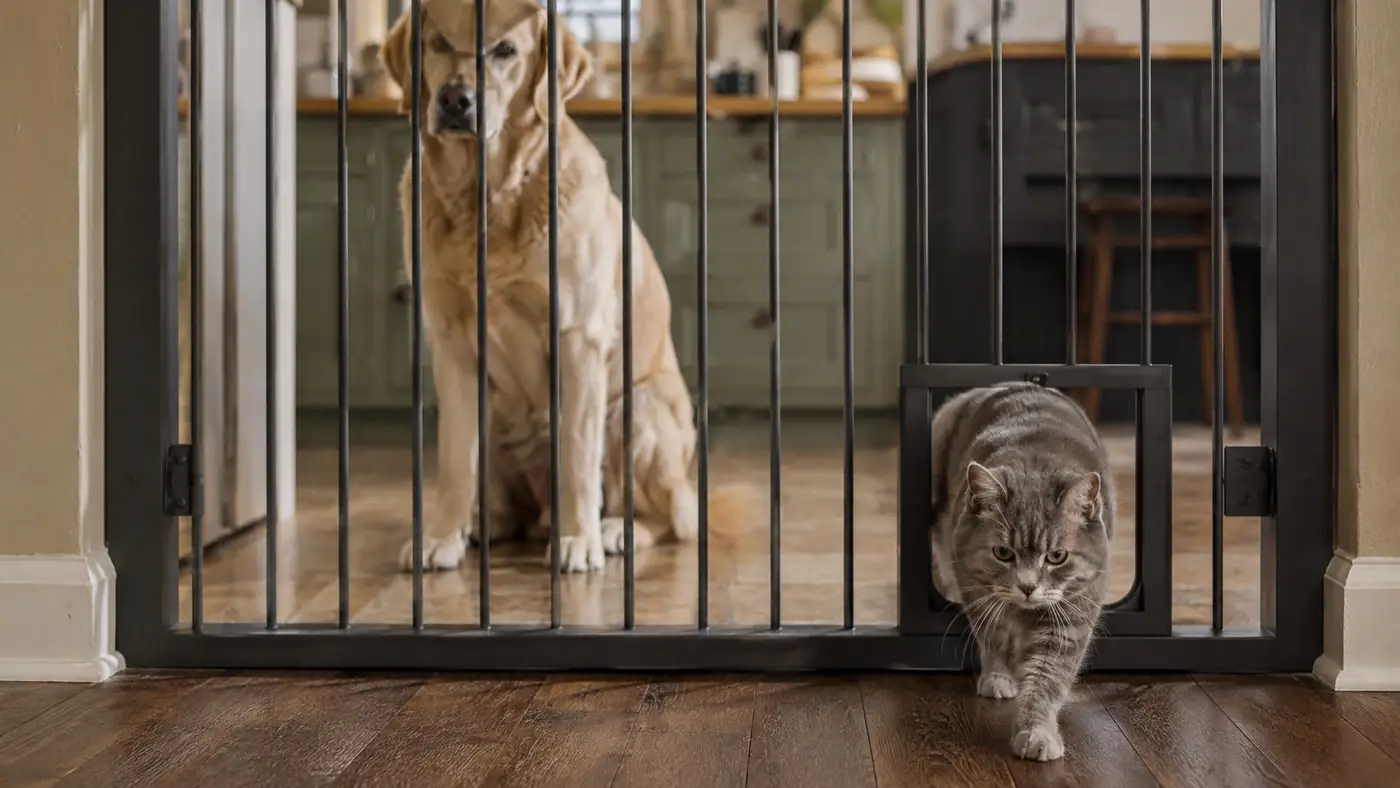
The small pet door is the detail that made this gate worth the extra cost in my specific house. Biscuit, my senior cat, needs to move freely between rooms that my current foster dog does not need access to. The cutout at the bottom corner of the Carlson gate is exactly her size, and she uses it several times a day without me lifting a finger. A standard gate has no equivalent, you either block your cat's access entirely or you leave the gate cracked open, which defeats the point of having one. The latch itself is also worth mentioning, it's a simple lift-and-swing design that I can operate one-handed with a leash in the other, which matters more than it sounds like it should when you're juggling a dog, a bag of groceries, and a door at the same time.
Tired of unmounting a gate every time you cross the kitchen?
The Carlson Extra Wide Gate is the one I recommend to every foster family managing more than one pet, because the walk-through door and small pet cutout solve problems a plain barrier never will.
Amazon Check Today's Price on Amazon →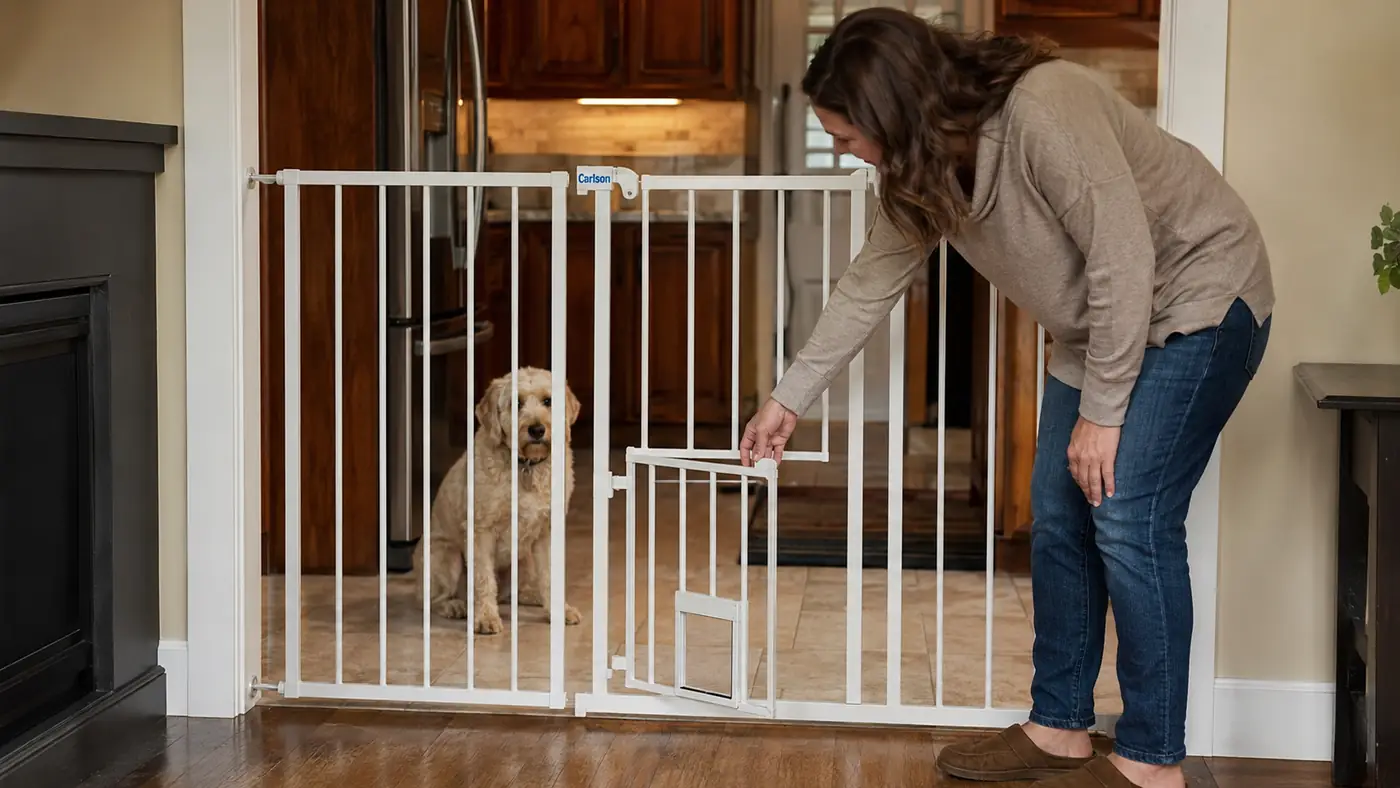
Where a Standard Pressure-Mount Gate Wins
I'm not going to pretend the walk-through style wins every category, because it doesn't. Standard pressure-mount gates are almost always cheaper, sometimes by fifteen or twenty dollars, and if you're gating off a narrow hallway or a laundry room that one calm dog rarely tests, that price gap matters more than a swinging door you'll use twice a week. I've recommended plain gates to foster families on tight budgets more than once, especially when the dog in question is small, low-energy, and not the type to lean into a barrier out of boredom.
Standard gates also tend to install a hair faster, since there's no walk-through mechanism to align and no latch to test. If you're setting up a temporary barrier for a one-night guest dog or a short foster stay, the five extra minutes the Carlson gate takes to mount correctly might not be worth it. A few of the newer foster volunteers I mentor start with a basic pressure-mount gate for exactly this reason, then upgrade to something like the Carlson once they realize how often they're managing more than one pet at a time. That's a legitimate path, and I'd rather point a reader toward the gate that fits their actual situation than push the pricier option on everyone.
A gate that's easier to remove than to walk through is a gate that eventually gets left open.
What Actually Changed My Mind
I used a plain pressure-mount gate for years before I switched. It worked fine for a single dog in a narrow hallway. What wore me down was adding a second dog and taking in fosters with wildly different temperaments, some of whom needed to be kept separate from my resident dogs entirely. Unmounting and remounting a gate ten or fifteen times a day, every day, is the kind of small friction that adds up to real resentment toward a product you technically didn't need to replace. The Carlson gate's walk-through door removed that friction completely, and once I stopped fighting with the gate itself, I actually used it consistently instead of propping doors shut with furniture, which is what I'd fallen back on more than once.
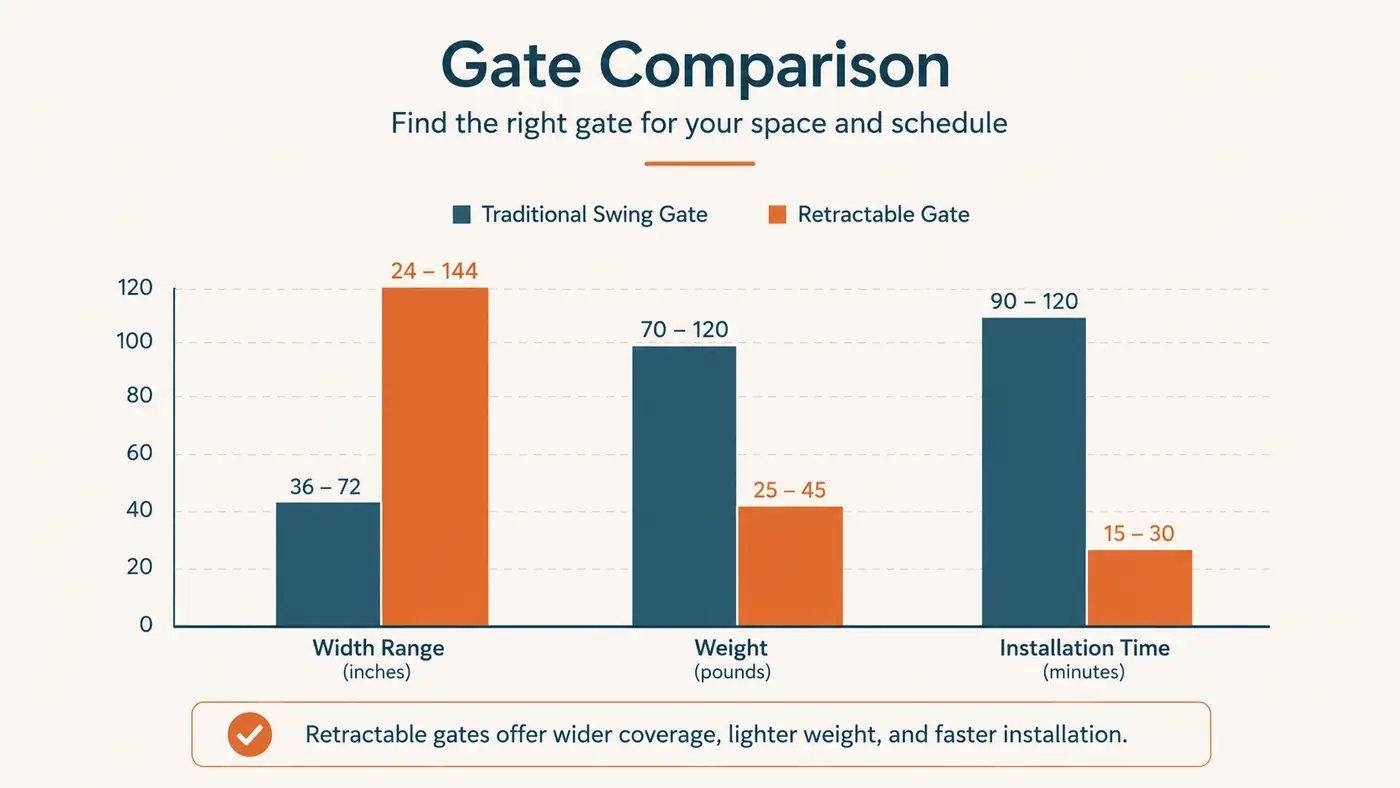
The tradeoff is real, though. The Carlson gate is taller and heavier than most standard models, which is part of why it holds up so well, but it also means it's not something you casually toss in a car for a weekend trip the way you might with a lightweight pressure-mount gate. I'd also add that the walk-through latch takes a little getting used to. My first week with it, I caught the door swinging back and clipping my ankle twice before I learned to nudge it shut behind me instead of letting it swing free. Not a dealbreaker, but not something the packaging warns you about either.
Installation, Wall Damage, and the Detail Most Buyers Skip
Both gate styles mount the same basic way, with rubber-capped wall cups that tighten against the door frame under pressure, and neither requires drilling. That said, the Carlson gate's wider extension range means more surface area pressing against your walls, which in my experience leaves a slightly more noticeable mark on painted trim over time than a narrower standard gate does. I renters-proof this by adding a thin strip of felt behind each wall cup, which costs about four dollars and solves the problem entirely. It's a five-minute fix that neither gate style mentions in its instructions, but it matters if you're in a rental or you just don't want dents in your door frame.
One thing both styles share is that pressure mounting is not appropriate at the top of a staircase, regardless of brand. I get asked this constantly, and the answer is the same for the Carlson gate and for any standard pressure-mount gate: use a hardware-mounted gate at stairs, full stop. Pressure mounting relies on wall tension holding the gate in place, and a determined dog or a stumbling toddler can pop a pressure-mounted gate loose at the exact moment you need it to hold. Both of these gates are built for doorways and room dividers on level ground, not for the top of stairs.
Durability and What Wears Out First
After a year of daily use, my Carlson gate's hinges show some wear but the frame itself hasn't bowed, chipped, or loosened at the wall cups. The walk-through latch is the part I check most often, since it's the one moving piece that takes repeated stress, and it still catches solidly. Standard pressure-mount gates, in my experience, tend to fail at the wall cup threads first, especially the plastic-reinforced models, where repeated tightening and loosening for storage or travel eventually strips the mechanism. I've gone through two cheaper gates that stopped holding pressure reliably within eight months, while my Carlson gate is heading into its second year without needing a replacement part. The powder coating has also held up better than I expected against drool and the occasional muddy paw print, a quick wipe with a damp cloth is usually all it needs.
Who Should Buy Which
Buy the Carlson Extra Wide Walk-Through Gate if you have more than one pet with different access needs, a doorway wider than the standard 32-inch range, or you're the kind of household that crosses the same gated doorway a dozen times a day. The built-in walk-through door and small pet cutout are built for exactly that repetition. Buy a standard pressure-mount gate if you have a single calm dog, a narrow hallway, a tighter budget, or you need something temporary that won't live in that doorway for more than a few months. Neither choice is wrong, but I'll say plainly that most of the multi-pet households I work with outgrow the standard gate faster than they expect, usually right around the time a second dog or a curious cat enters the picture. When that happens, the walk-through door stops being a nice-to-have and starts being the whole reason the gate gets used correctly instead of propped open.
Managing more than one pet through the same doorway?
If you're crossing that gate more than a few times a day, the Carlson's walk-through door and small pet cutout make it the barrier that actually gets used instead of left open.
Amazon Check Today's Price on Amazon →