
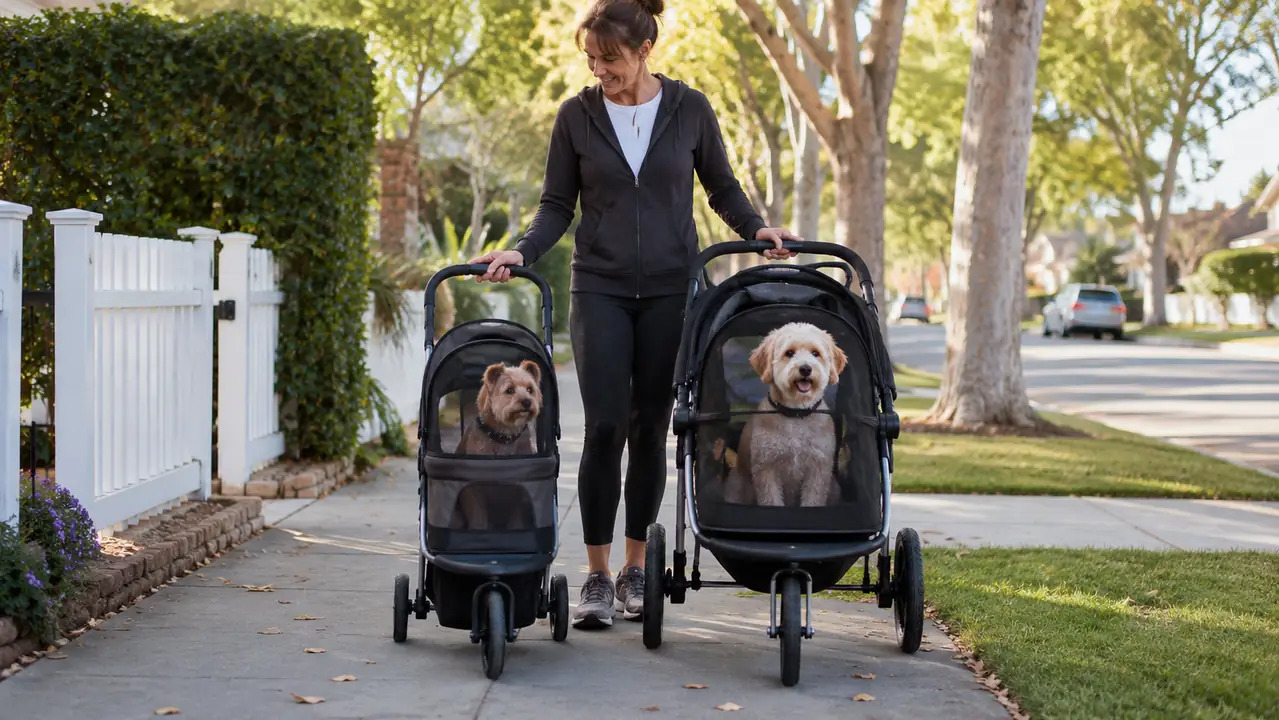
Short answer: if most of your walks happen on sidewalks, at the vet, or around a store, and you need something you can fold with one hand and toss in a trunk, get the BestPet 3-Wheel Pet Stroller. If you actually run, or your walks cover gravel trails and uneven ground for miles at a time, a dedicated jogging pet stroller with real suspension and bigger tires is worth the extra money and bulk.
That's the whole verdict. Everything below is why I landed there, after running both stroller styles through actual walks with actual dogs. I've fostered rescues for fifteen years out of a place in Ohio, and right now that means two dogs, Duke and Ranger, plus a fifteen-year-old cat named Biscuit who mostly stays home but has ridden in a stroller more than once during vet visits. BestPet is the stroller I bought first because it was cheap enough to try without agonizing over it, and it's stayed in regular rotation for the fosters who can't walk far, the small dogs who get overwhelmed by bigger dogs at the park, and Biscuit's occasional trips outside. A jogging stroller does a different job, and I've borrowed one from a fellow foster volunteer enough times to know exactly where it beats the BestPet and where it's overkill.
| BestPet 3-Wheel Pet Stroller | Dedicated Jogging Pet Stroller | |
|---|---|---|
| Wheel type | Three smaller wheels with a locking front swivel, hard rubber-and-plastic construction | Three larger air-filled or foam tires built for trail terrain, front wheel usually locks straight for running |
| Suspension | None built in, relies on the mesh seat and light frame flex to absorb bumps | Actual shock-absorbing suspension on most models, designed for jogging pace over uneven ground |
| Folded size | Folds down small enough for a hatchback trunk or a hall closet in seconds | Folds larger and heavier, most won't fit in a small trunk without rearranging |
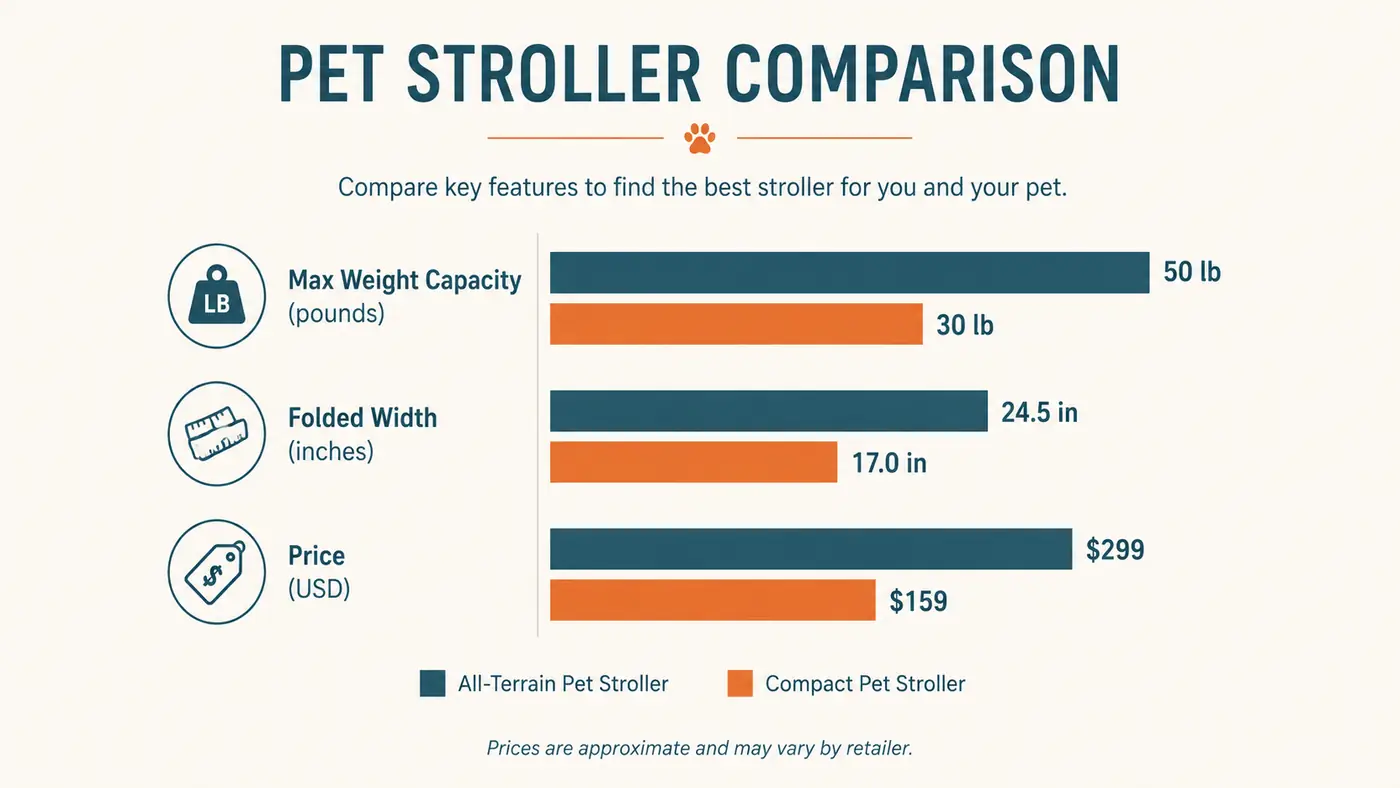
| Max pet weight | Rated for smaller and mid-size pets, comfortable up to roughly 30 pounds | Rated higher, often 75 to 150 pounds depending on the model, built for bigger dogs |
| Breathability | Breathable mesh dome and sides, good airflow for shorter trips | Varies by model, some use heavier canvas that traps more heat on long runs |
| Storage | Small basket underneath, enough for a leash, water bottle, and a few treats | Larger storage compartment, often with cup holders and room for a real gear bag |
| Price today | Check today's price on Amazon | Typically three to five times more than a compact stroller like the BestPet |
| Best for | Sidewalks, vet trips, small dogs, senior pets, quick errands | Actual jogging or running, gravel trails, larger dogs, longer distances |
Where the BestPet Stroller Wins
Portability is the whole reason I still reach for the BestPet stroller over the jogging model I've borrowed. It folds with one hand in about three seconds and slides into the trunk of my hatchback without me having to rearrange anything else back there. When I'm hauling a foster to a vet appointment, or Biscuit needs to come along for a checkup and can't walk the parking lot on her own anymore, I don't want to wrestle with a bulky frame before I've even gotten out of the driveway. The BestPet stroller lives folded flat behind my back seat most of the time, ready to pop open the second I need it, and that low-friction convenience is what actually gets a stroller used regularly instead of left in the garage.
Weight and price matter here too. A jogging stroller is a real financial commitment, and for a lot of pet owners it's solving a problem they don't actually have. My foster Pearl came to me as a twelve-pound terrier mix who'd never needed a walk longer than a block before her hip surgery, and the BestPet stroller was exactly enough stroller for her recovery period, breathable mesh so she didn't overheat, light enough that I could carry it up my porch steps one-handed with her still inside, and cheap enough that buying it for a temporary foster situation didn't feel wasteful. If your walks are neighborhood-length and your dog is small to mid-size, you're paying for suspension and tire durability you'll never test.
Need a stroller that folds in seconds and fits in your trunk?
The BestPet 3-Wheel Stroller is the one I keep reaching for on vet days and short walks, because it's light, breathable, and doesn't take up half my hallway when it's not in use.
Amazon Check Today's Price on Amazon →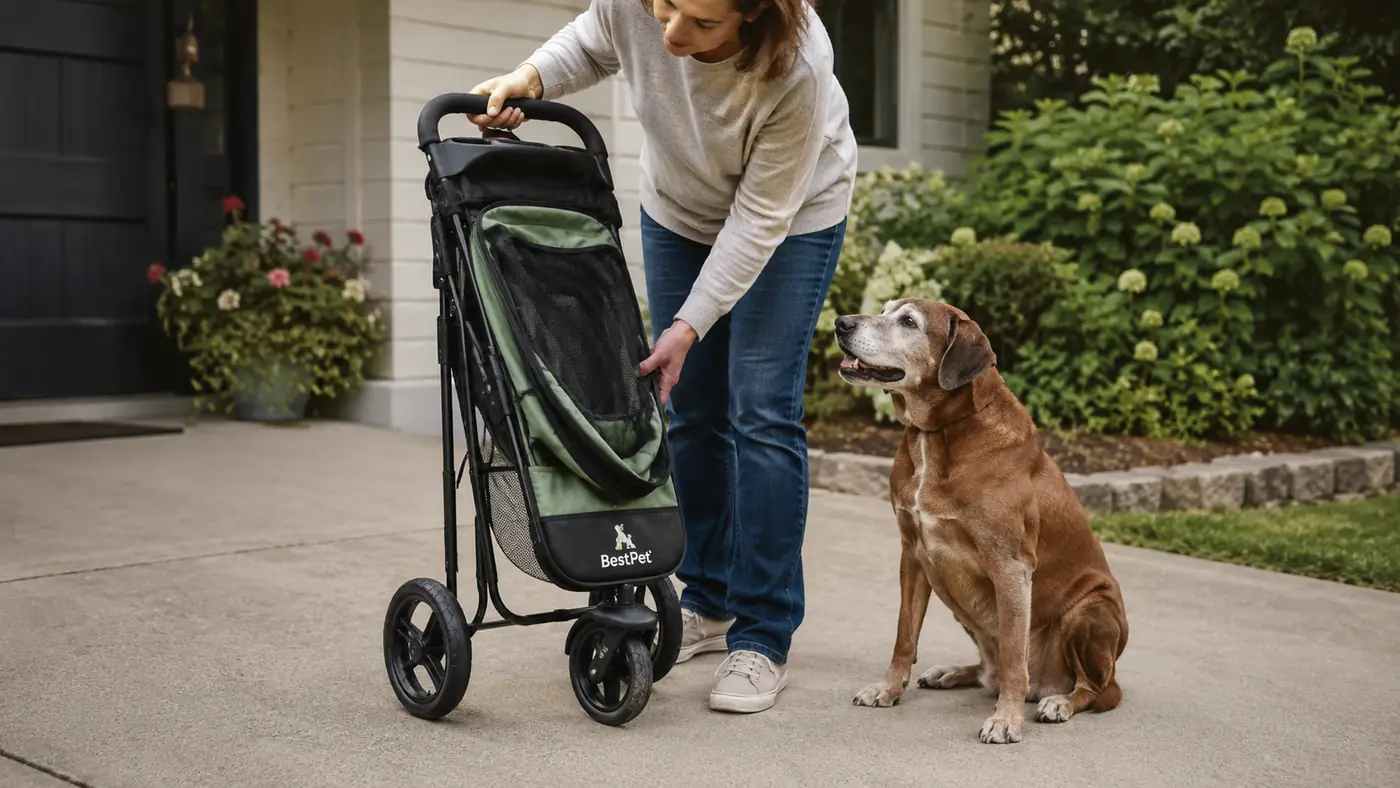
Where a Jogging Pet Stroller Wins
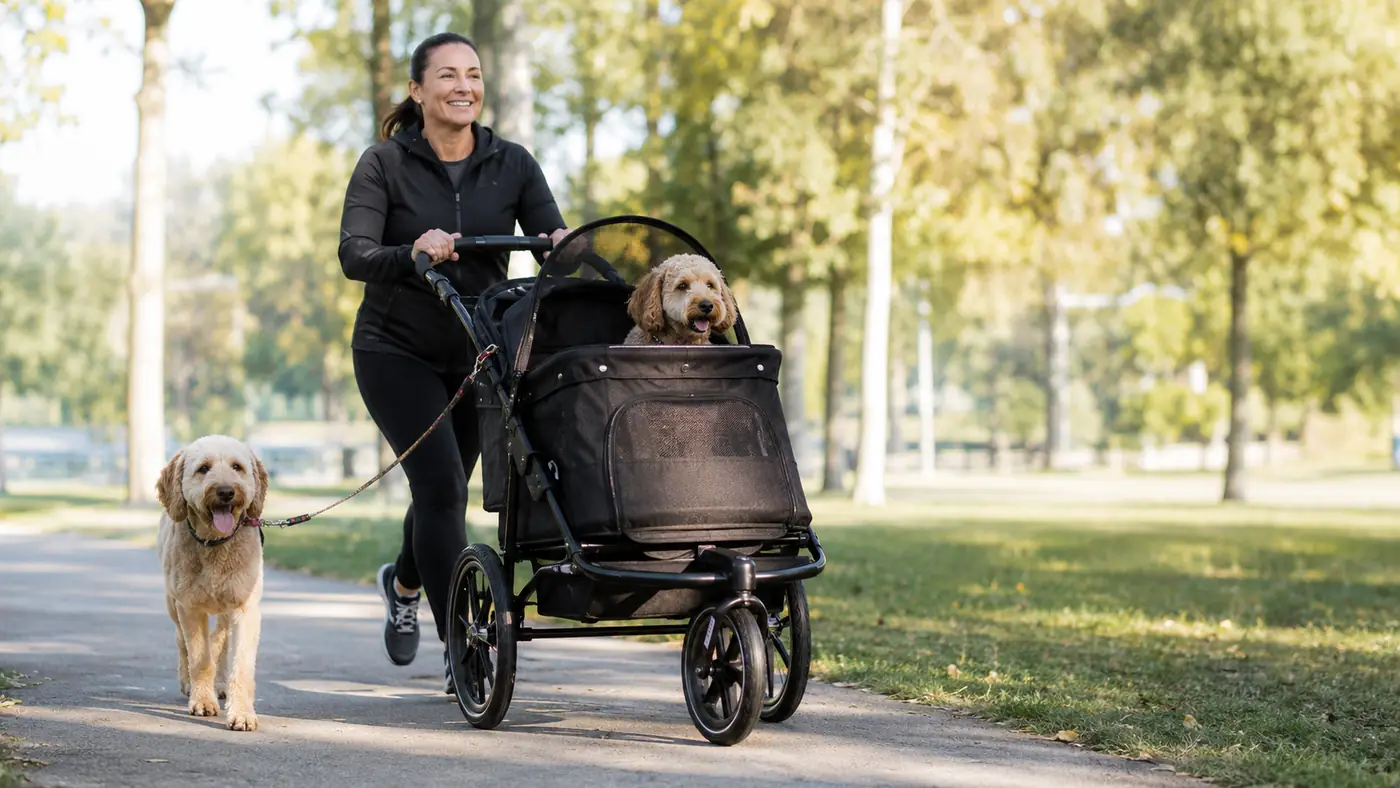
I'm not going to pretend the compact style wins every category, because it doesn't. A dedicated jogging pet stroller has real suspension, which matters enormously the second you're moving faster than a walk or covering ground that isn't smooth pavement. I borrowed one from another foster volunteer for a summer when I was taking Duke, my bigger dog, on longer trail loops while he recovered from a torn pad, and the difference on gravel was obvious within the first quarter mile. The BestPet stroller's small wheels transmit every bump straight up into the seat, which is fine at walking pace on a sidewalk and genuinely uncomfortable at a jog on uneven dirt.
Weight capacity is the other place the jogging stroller pulls ahead by a wide margin. The BestPet stroller is built for pets up to roughly 30 pounds, which covers most of my fosters but not Duke, who's a 68-pound lab mix, and definitely not the occasional larger senior dog I've taken in whose back legs give out before the rest of them does. If you've got a big dog who genuinely can't run anymore but still needs to move, a jogging stroller rated for 75 pounds or more isn't a luxury, it's the only option that physically holds your dog. The bigger storage compartment on most jogging models is a real convenience too, room for a water bottle, a leash, poop bags, and your own phone and keys without anything falling out over rough terrain.
A jogging stroller solves a problem most pet owners don't have, but for the ones who do, nothing else works.
What Actually Changed My Mind on This
I bought the BestPet stroller first because it was affordable and I wasn't sure I'd use a stroller often enough to justify anything bigger. That turned out to be the right call for most of what I do, short trips, vet visits, small fosters recovering from surgery. What surprised me was how quickly I hit its limits with one specific foster, a senior dog named Tank who weighed close to 40 pounds and had arthritis bad enough that he needed to be pushed rather than walked most days. He fit in the BestPet stroller, technically, but the mesh sagged under his weight and the frame felt genuinely strained on anything longer than a flat driveway loop. That's when I understood the weight rating wasn't a suggestion, it was describing where the frame actually starts to struggle.
The flip side showed up with a foster kitten named Pixie, barely four pounds and terrified of the outside world after we pulled her from a rough situation. The BestPet stroller's breathable mesh dome let her see out without feeling exposed, and its light weight meant I could push her one-handed while holding a leash in the other for Ranger, my second dog, on the same walk. A jogging stroller would have been enormous overkill for her, heavier to maneuver, harder to fold on the fly if she panicked and I needed to pick her up quickly. Matching the stroller to the actual pet in front of you matters more than picking whichever one looks more capable on paper.
Terrain, Speed, and the Detail Most Buyers Skip
The single biggest factor in this decision isn't your dog's size, it's what surface you're actually pushing the stroller across and how fast you're moving. Sidewalks, tile floors at the vet, smooth parking lots, all of that is comfortably within what the BestPet stroller's small wheels can handle without jostling the pet inside. Gravel driveways, park trails, grass with roots underneath, any of that at walking speed is still fine. The moment you introduce jogging speed on anything other than pavement, the small wheels start hopping over every bump instead of rolling through it, and that's uncomfortable for a nervous or recovering pet in a way that defeats the purpose of using a stroller at all.
I'd also flag that neither stroller style is meant for genuinely rough terrain, mud, deep gravel, or anything with a real incline. Even a proper jogging stroller with suspension is built for maintained trails and running paths, not off-roading. If your walks regularly go somewhere that rugged, you're better off with a soft carrier or a supportive harness for the short rough stretch, then transferring your pet back into whichever stroller fits your speed once you're back on smoother ground.
Durability and What Wears Out First
My BestPet stroller is now two years into regular use, mostly short trips a few times a week, and the frame hasn't bent or loosened at the joints. The mesh has held up better than I expected against claws, though I did have one foster, Otis, snag a small hole in the side panel during an anxious moment on his first ride, easily patched with a strip of fabric tape. The zippers on the top opening are the part I watch most closely, since they're the first thing to feel gritty if you don't wipe them down after a dusty walk. A jogging stroller, from what I've seen with the borrowed one, wears differently, the tires are the part that eventually needs attention, since they're doing real work absorbing impact on rough ground, but the frame itself tends to outlast a compact stroller simply because it was built heavier from the start.
Who Should Buy Which
Buy the BestPet 3-Wheel Stroller if your dog or cat is under 30 pounds, your walks are mostly sidewalks and errands, and you want something that folds in seconds and doesn't eat up trunk space or closet room. It's the stroller I hand to nearly every new foster family, because it's affordable enough to try without a big commitment and light enough that anyone can manage it one-handed. Buy a dedicated jogging pet stroller if you actually run, your dog is over 40 or 50 pounds and can't walk far anymore, or your regular routes include gravel trails and uneven ground where real suspension makes the ride noticeably more comfortable. Neither is the wrong choice, but I'll say plainly that most pet owners overestimate how much stroller they need. Start with what matches the walks you're actually taking this month, not the ones you might take someday.
Pushing a small dog or recovering pet around the neighborhood?
If your walks are sidewalks, vet trips, and quick errands rather than trail runs, the BestPet Stroller's light frame and one-hand fold make it the one that actually gets used.
Amazon Check Today's Price on Amazon →