
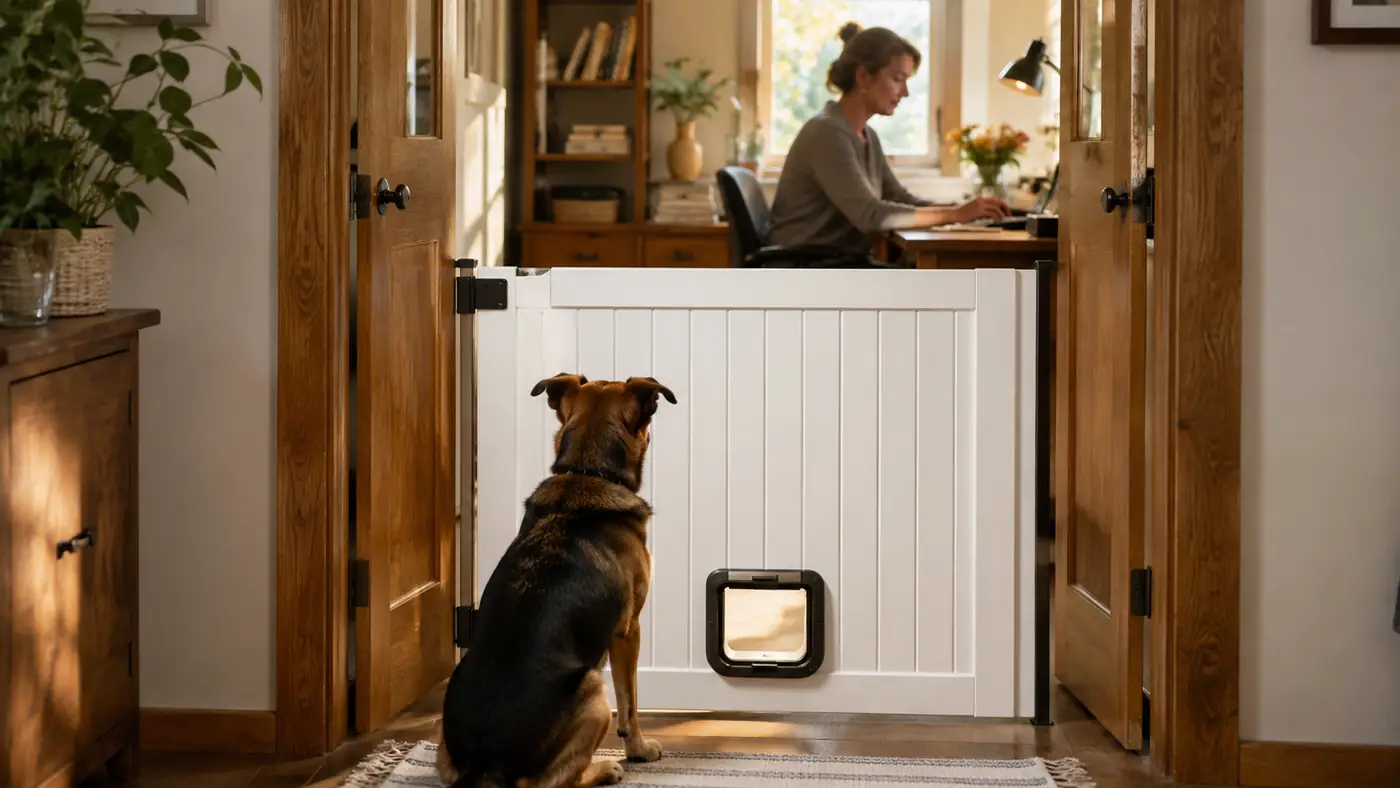
My husband turned our spare bedroom into a home office two years ago, and almost immediately Ranger decided the space under the desk was the best napping spot in the house, trash can included. Closing the door full time wasn't really an option since that room shares a return air vent with the hallway and gets stuffy fast when it's sealed shut all day. What we actually needed was a way to block Ranger out of one room without closing a door on it, and that's exactly the problem a Carlson gate solves. I installed a Carlson Extra Wide Walk-Through Gate across that doorway, the same gate style I now recommend to a dozen foster families who've asked me the same question, how do you keep a dog out of one specific room without living behind a shut door.
This guide walks through exactly how I did it, from measuring the doorway correctly to actually training Ranger to respect the gate instead of testing it every single day. None of this is complicated, but there are a handful of steps people skip that turn a perfectly good gate into something that gets propped open within a month, and I've watched that happen to enough foster families to know exactly where the process breaks down.
Before you measure a doorway for a gate that won't hold
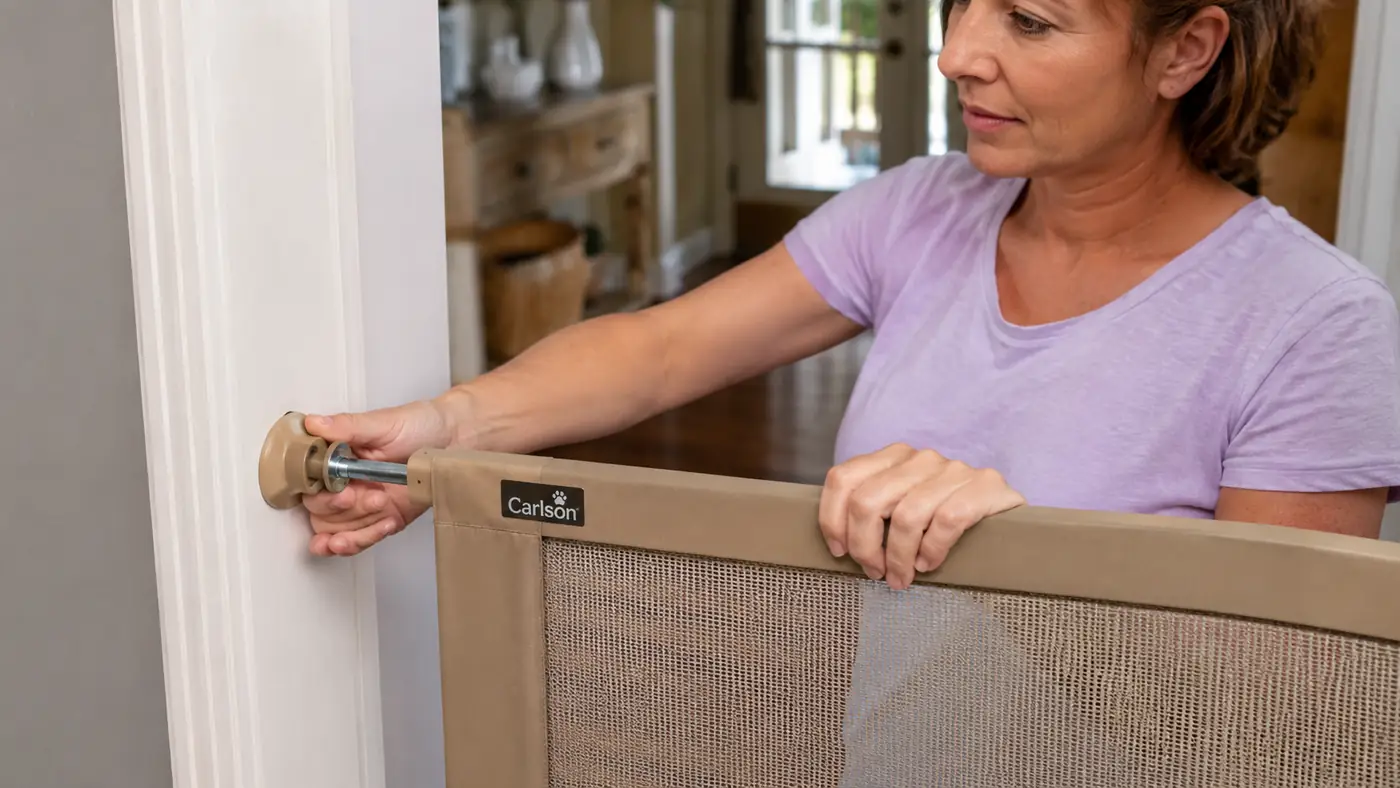
A pressure mounted gate only works long term if it actually fits your doorway and gives you a way through it without unmounting the whole thing. The Carlson Extra Wide Walk-Through Gate covers 29.5 to 36.5 inches and has a built-in door for exactly that reason.
Amazon Check Today's Price on Amazon →Step 1: Measure the Doorway Before You Buy Anything
Grab a tape measure and check the doorway at its narrowest point, not just at the floor, since trim and hinges can pinch the opening a half inch or more in older houses like mine. Our office doorway measures just over 34 inches, which put it outside the range of most standard 29 to 32 inch gates before I even started comparing prices. If your doorway runs wide, you need a gate rated for that width, not a standard gate stretched to its absolute limit with an add-on extension panel, which is exactly the kind of setup that flexes and eventually pops loose.
Height matters just as much as width, especially if the dog you're blocking is a jumper. Ranger is a 45 pound mixed breed who used to clear a 24 inch gate without much effort, so I measured him standing on his back legs before I bought anything. Most extra wide walk-through gates run around 30 inches tall, which has been enough to keep Ranger from even attempting it, but if you've got a dog who's cleared gates before, measure for that specifically instead of assuming a taller gate automatically means a safer one.
It's also worth checking your doorway's trim before you shop, since some pressure mounted gates need flat, solid contact points on both sides to seat correctly. Ours has a slightly rounded doorframe casing from an older renovation, and I had to double check the gate's wall cups would still sit flush before I ordered one. A five minute check with a level saved me from returning a gate that looked fine in photos but wouldn't have mounted evenly in our specific doorway.
Step 2: Choose a Walk-Through Style Instead of a Plain Barrier
A plain gate you have to step over or fully unmount every time you cross it sounds fine in the store and turns into a daily annoyance within a week. I learned this the hard way with a cheaper gate years before I switched to a Carlson gate. Every trip to the laundry room with an armful of towels meant setting the basket down, unhooking the gate, stepping through, and remounting it, or just stepping over it and hoping Ranger didn't dart past me in the two seconds the gap was open. A gate you avoid using correctly is a gate that stops doing its job.
A walk-through gate solves that with a small swinging door built into the panel, latched high enough that a dog can't nose it open, but low enough for you to push through with a hip or a free hand. The Carlson gate's walk-through door is the single feature that made this whole setup something I actually use every day instead of something I fight with. If you're blocking a room you personally need to enter and exit more than once or twice a day, a walk-through gate is worth the extra few dollars over a plain barrier every time.
I'd also think about material before buying. Mesh panel gates like the Carlson give you a clear sightline into the room, which matters if you're gating off a home office or nursery and want to check on things without opening the gate. Solid panel gates block the view entirely, which some owners actually prefer for a dog who gets overstimulated watching activity through a barrier. Know which behavior you're managing before you pick the style, since the wrong one can make a mildly anxious dog worse.
Step 3: Mount It So Pressure Holds It, Not Guesswork
Pressure mounted gates rely on rubber-capped wall cups pressing against your door trim under tension, and getting that tension right is the difference between a gate that stays put and one that slides sideways the first time a dog leans on it. I set the gate in the doorway, extend the tension bar until the wall cups sit flush against the trim on both sides, then lock it down. It took me about fifteen minutes the first time, mostly because I kept checking that both sides were seated evenly before locking the bar.
Before I let Ranger anywhere near it, I test the gate myself. I push on the panel from both directions, rock it side to side, and lean my own body weight against the walk-through door the way a curious dog eventually will. If it shifts even slightly, the tension isn't set right yet. I also slide a thin strip of felt behind each wall cup, a trick I picked up after wide gates started leaving faint marks on the trim in our older house, and it hasn't dented the paint since.
One rule I repeat to every foster family I talk to: pressure mounted gates are for doorways and room dividers on level ground, never for the top of a staircase. A determined dog or a distracted person can pop a pressure mounted gate loose at exactly the wrong moment on stairs, and that's a job for a hardware mounted gate screwed into the frame instead. I've had well meaning foster families ask if they can just use the same gate at both spots to save money, and I tell them the same thing every time, buy the right gate for each job.
Step 4: Teach Your Dog the Gate Means This Room Is Off Limits
Once the gate is mounted, I don't just expect a dog to understand the rule on sight. I let a new foster, most recently a shepherd mix named Otis, sniff the gate for a few minutes with no pressure attached, then I sit nearby while he tests it, pawing at the mesh panel or leaning against the frame to see if it gives. It didn't, and within a day Otis stopped testing it altogether. Dogs figure out a boundary is real a lot faster than we give them credit for, as long as the gate itself never wobbles or gives an inch when they push.
For the first week, I reward calm behavior near the gate instead of only correcting the dog for testing it. If Ranger walks past the office doorway without pawing at the panel, he gets a quiet good boy and sometimes a treat. If he does paw at it, I don't yell, I just redirect him to another spot and ignore the behavior. Consistency here matters more than any single correction. A gate that's enforced sometimes and ignored other times teaches a dog that testing it occasionally pays off.
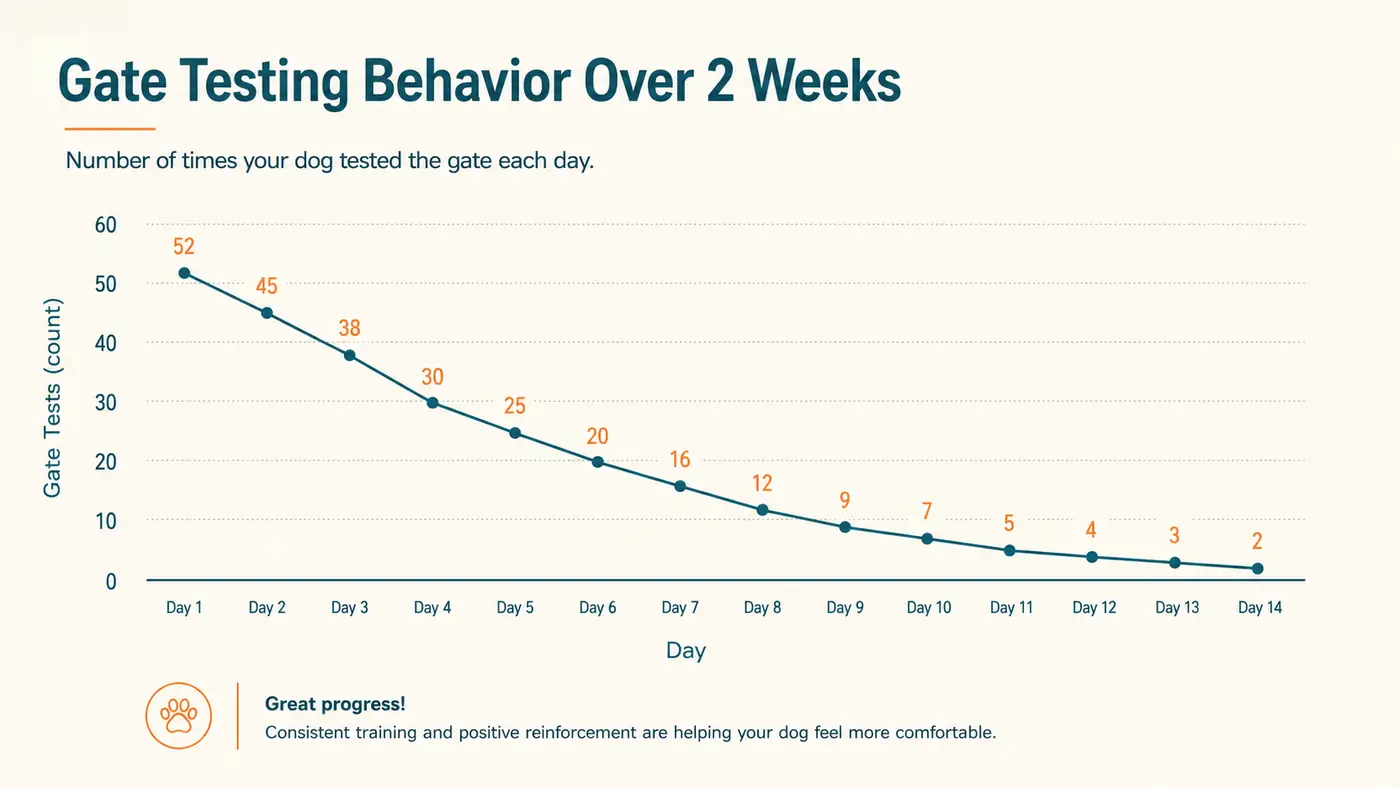
Some dogs test a gate with their whole body instead of just a paw. I've had a foster lean full weight against the mesh panel just to see what happens, and it's exactly why the mounting step matters so much. A gate that holds firm under that kind of pressure gets accepted as a real boundary within days. A gate that gives even slightly teaches a dog the barrier is negotiable, and that lesson is hard to undo once it's learned. A foster named Pearl, a senior beagle who'd never seen a gate before landing with us, needed almost two weeks of this consistency before she stopped testing the panel altogether, longer than most dogs, but the same process worked eventually.
Step 5: Build the Habit of Using the Walk-Through Door Yourself
The gate only stays up long term if you actually use the walk-through door instead of unmounting the whole gate every time you're in a hurry. This sounds obvious, but it's the step I see people skip most, and it's the reason so many gates end up folded flat in a closet within a couple of months. I keep a small basket of dog treats on a shelf right next to our office doorway, partly for training but mostly because it reminds me to push through the small door properly instead of shortcutting the system I built.
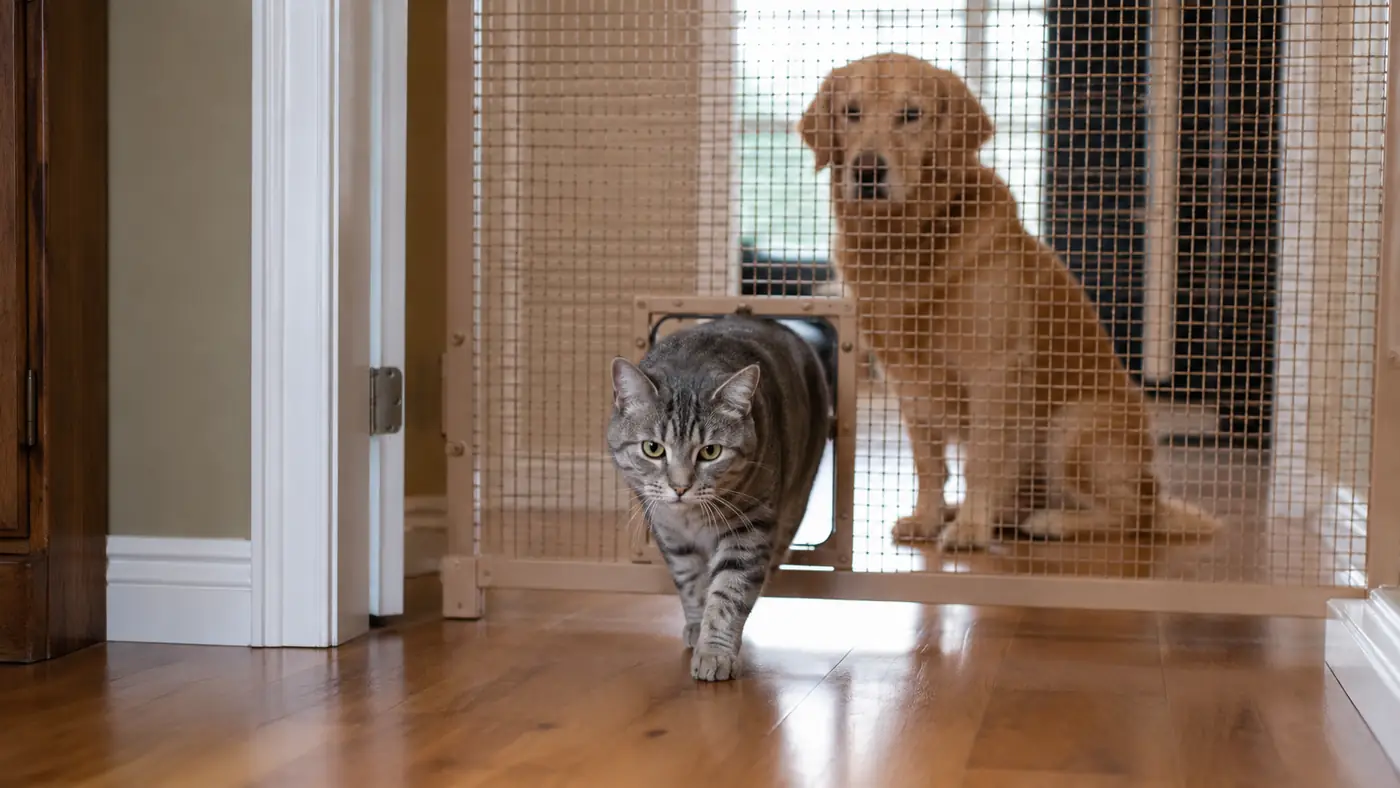
If you've got a cat in the house, look for a gate with a small pet door cut into the bottom corner, the way our Carlson gate has. Biscuit, our senior cat, uses that cutout several times a day to move between rooms Ranger isn't allowed in, without me lifting a finger or opening the whole gate. It's a small detail, but in a multi pet house it's the difference between a gate that manages one animal and a gate that actually fits how your whole household moves through the day.
Within about two weeks, using the walk-through door stopped feeling like an extra step and started feeling like the normal way to cross that doorway. Ranger still checks the gate out of habit sometimes, mostly by pausing at it before walking away, but he hasn't tried to push past it in months. That's really the whole goal of this process, a boundary that holds without you having to think about it every single day.
What Else Helps
A few small habits kept our gate working well past the first few months. I check the tension bar every couple of weeks, giving it a quarter turn if I notice any wobble, since seasonal humidity can shift wood door frames enough to loosen a pressure mount slightly. I also wipe the mesh panel down weekly, since muddy paws and drool build up fast in a house with more than one dog moving past it daily. And if you're gating off a room for a new foster dog rather than a resident one, give them a few days of supervised access to the gate before leaving them alone with it, since an anxious dog under stress will test a barrier harder than a settled one will.
One more thing worth saying plainly: a gate is a management tool, not a training replacement. Ranger doesn't go into the office when the gate's down for cleaning because he's learned the rule over time, not because a barrier alone taught him restraint. Use the gate to prevent the behavior while you're building that habit, not as a permanent substitute for it, and you'll find you need the gate up less often as the months go by. I still keep the gate mounted year round, even now that Ranger mostly respects the room on his own, because the one time I took it down for a party, he was back under that desk within an hour.
A gate you have to unmount to use correctly is a gate that eventually gets propped open for good.
Ready to block off one room without shutting a door on it?
The Carlson Extra Wide Walk-Through Gate fits doorways up to 36.5 inches, holds firm under a leaning dog, and gives you a way through it without unmounting anything. It's the same gate keeping Ranger out of our office right now.
Amazon Check Today's Price on Amazon →