
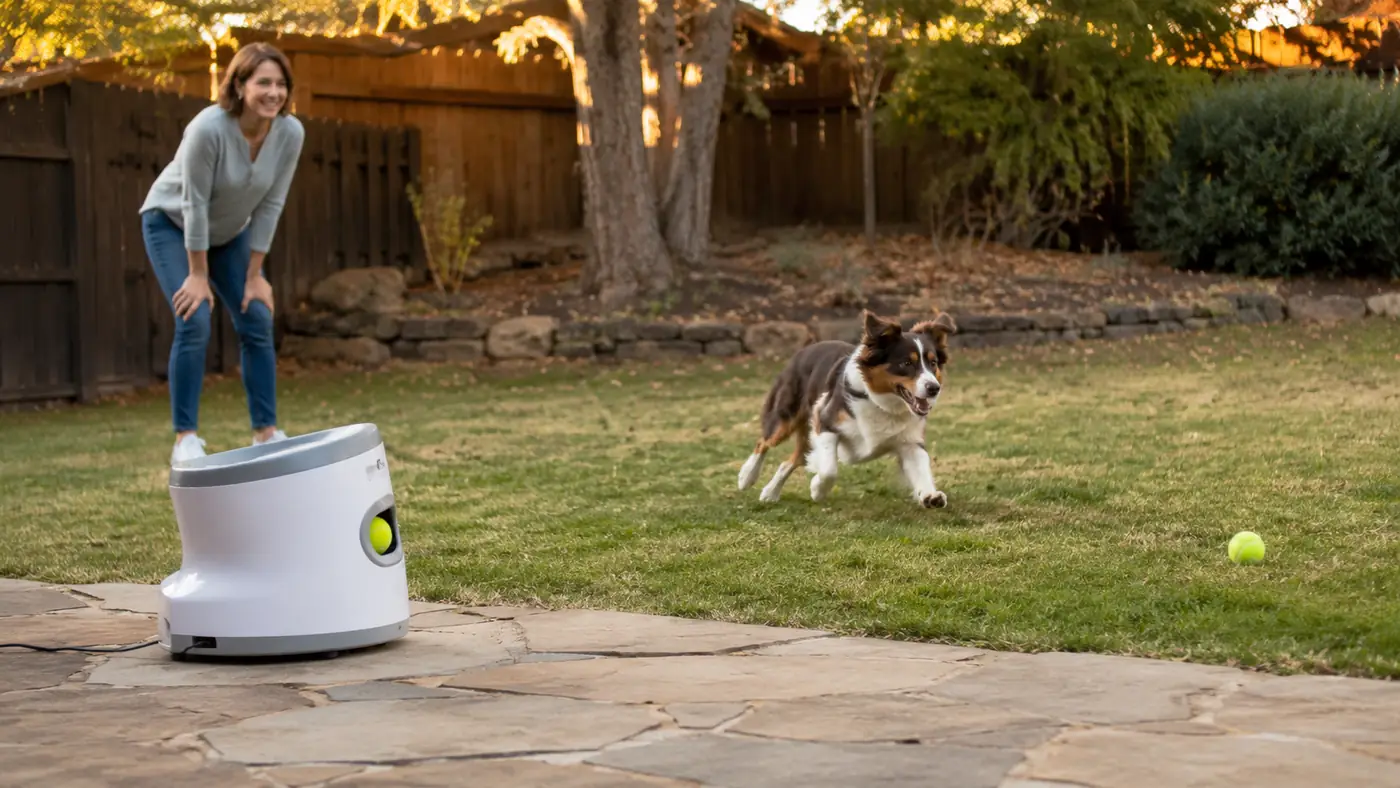
I bought the MEKAPLE automatic ball launcher in January mostly out of self-preservation. Gus, our four-year-old mixed breed foster-turned-permanent, has the kind of energy that does not taper off with age the way Duke's did. Duke is twelve now, a Lab mix who used to run me ragged in his own younger years, and he has earned his afternoons on the porch. Gus never got that memo. He wants fetch at seven in the morning, fetch at noon, and fetch again the second I walk in the door from the feed store, and after fifteen years of fostering out of our house in central Ohio, my shoulder finally told me it was done being the ball-throwing machine. The MEKAPLE launcher has run in our backyard almost every day since, and I want to walk through what six months of real use looks like, not the first-week honeymoon phase most reviews stop at.
For anyone who has not shopped this category before, the MEKAPLE is a squat, motorized box that sits on the ground, holds a hopper of mini tennis balls, and fires them out one at a time on a timer or a button press, at whichever of the three distance settings you choose. I ordered it during a stretch when Gus was digging holes along the fence line out of sheer boredom, and I needed something that could exercise him without me spending my only free hour of the day standing in the yard with a sore arm.
The Quick Verdict
A genuinely durable, high-energy-dog solution that has held up to six months of near-daily backyard fetch, though it needs a decent stretch of open lawn and more upkeep than the marketing photos let on.
Amazon Check Today's Price →One tired dog is worth more than one tired arm.
If you've got a dog whose energy outlasts your patience for standing in the yard throwing a ball, an automatic launcher takes that job off your plate the way this one did for us.
Amazon Check Today's Price on Amazon →How I've Used It
The launcher lives on our back patio from roughly March through November, and I bring it into the garage for the coldest stretch of winter since I do not trust an electronic housing to love an Ohio deep freeze the way I do. Most days it comes out around four in the afternoon, right when Gus starts pacing the kitchen and nosing at the back door, which is his version of clocking me in for the second shift of the day.
Setup the first time took me about ten minutes, most of it spent reading the quick-start card twice because I did not want to load the hopper wrong and jam it on day one. I picked the middle of the three distance settings for our yard, which runs about forty feet from the patio to the fence line, and that setting has stayed put ever since. I have only touched the distance dial twice in six months, once to test the shortest setting for a rainy day when Gus was stuck fetching in the mudroom, and once to see if the longest throw would clear our whole yard, which it very nearly did.
A typical session runs fifteen to twenty minutes, which is long enough that Gus is visibly winded by the end of it and short enough that I can start dinner right after. I load the hopper with ten to twelve balls at a time, and Gus has gotten fast enough at the retrieve-and-drop routine that we rarely run out mid-session. Duke watches from the porch most days, occasionally wandering over to steal a ball out of pure spite, and our senior cat Biscuit keeps her distance entirely, which I consider the correct call on her part.
Build Quality After Six Months of Real Yard Use
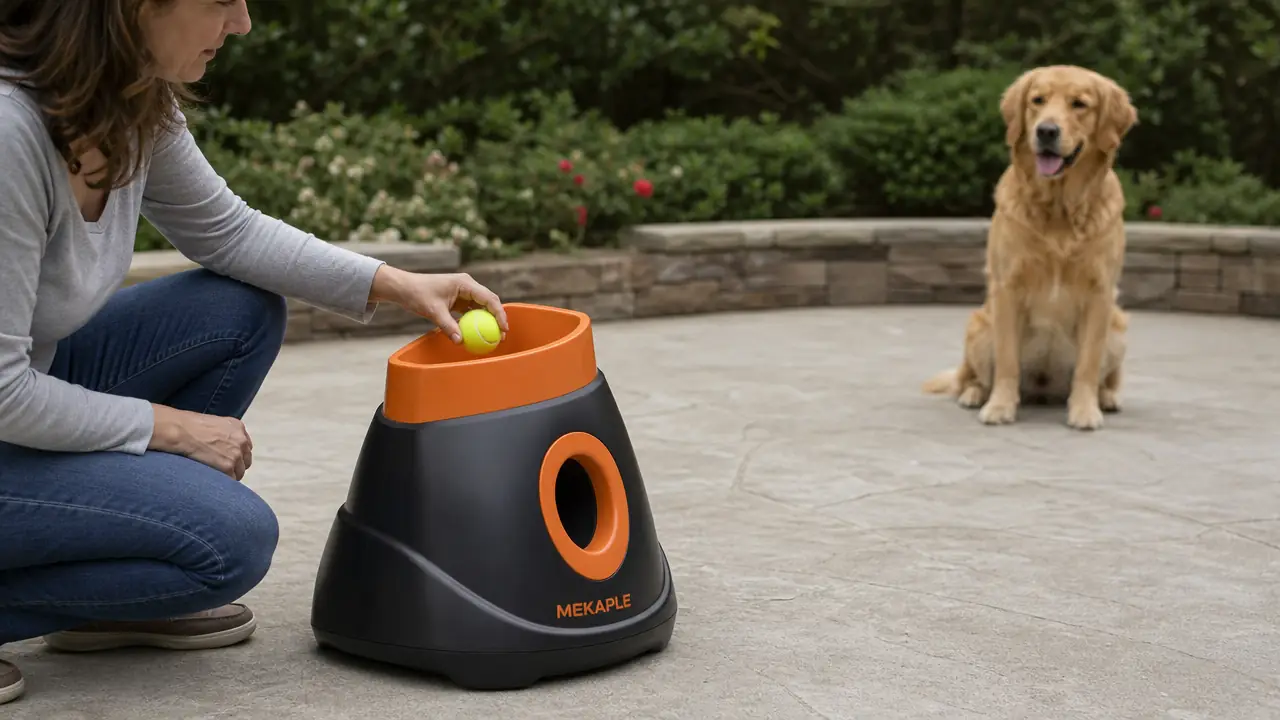
The plastic housing has taken a beating and shows it mostly in scuffs, not cracks. It has been rained on more than once when I forgot to bring it in before a pop-up Ohio thunderstorm, kicked over by Gus in his excitement at least a dozen times, and dragged across the patio stones when I moved it to a new spot to keep from wearing a bald patch in one section of grass. None of that has affected how it throws. The housing still sits level, the chute still feeds balls one at a time without double-loading, and the launch arm has not developed the wobble I half expected by month four.
What has worn down is the traction on the bottom feet, which were grippy out of the box and have smoothed over with six months of being dragged around on stone and grass. On a damp morning the unit can slide an inch or two backward when it fires, which nudges the aim slightly off center by the end of a long session. It is a minor annoyance, not a functional failure, and a rubber mat underneath solved most of it.
The mini tennis balls that came with it have not fared as well. Gus's jaw pressure has flattened three of the original fifteen into something closer to a Frisbee than a ball, and I replaced those out of pocket with a fresh multi-pack rather than try to feed a misshapen ball through the chute and risk a jam. That felt like a normal cost of owning any dog toy with Gus in the house, not a strike against the launcher itself.
How Gus's Energy Level Changed Over the Months
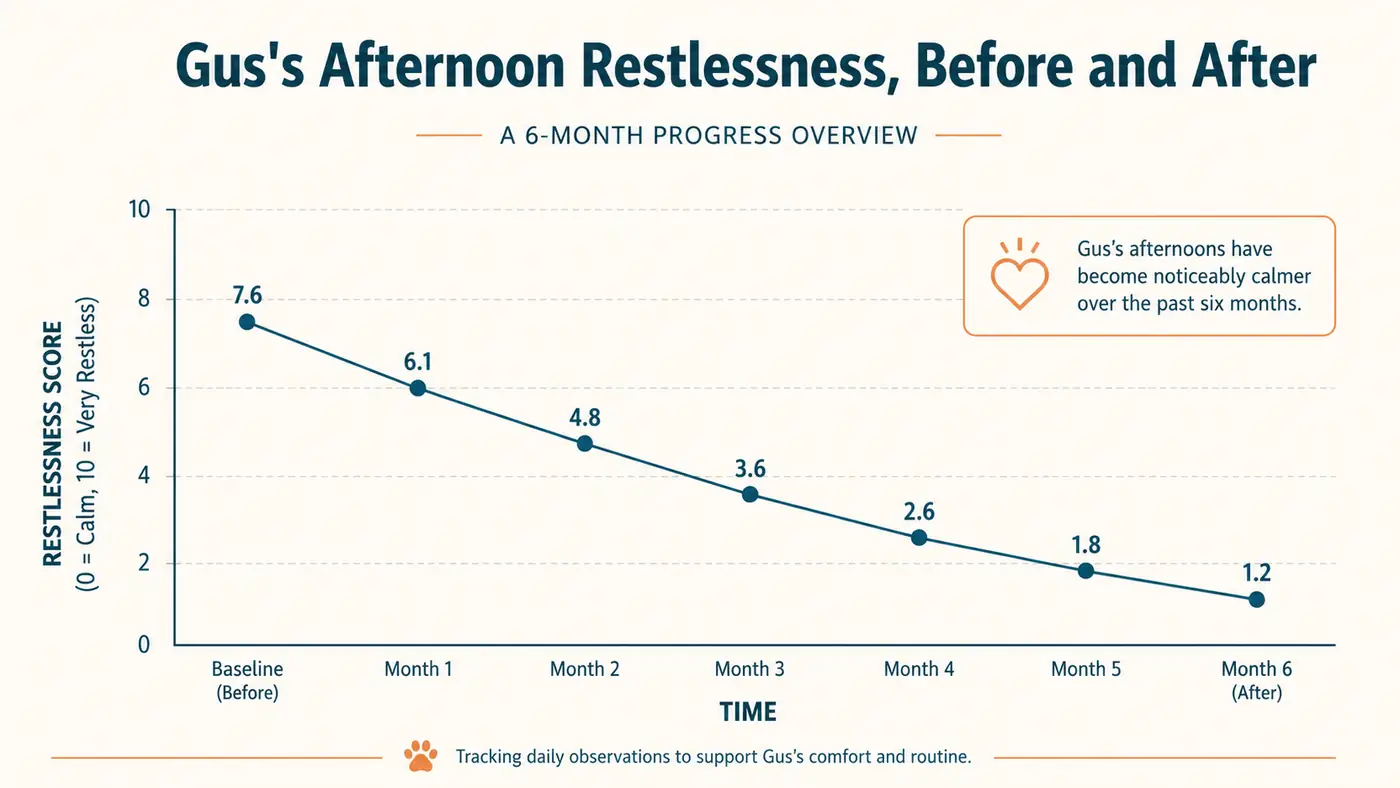
I did not expect a plastic box to change my evenings as much as it has. By month two, the four o'clock pacing and door-nosing had noticeably calmed down, not because Gus needed less exercise but because he knew relief was coming on a predictable schedule. Dogs settle faster when they trust the routine, and once he learned that patio time meant real, sustained fetch rather than five distracted throws from a tired human, he stopped escalating his bids for attention earlier in the day.
The digging along the fence line, which was my original problem to solve, dropped off almost entirely by month three. I cannot prove a direct line between the launcher and that change, but the timing lines up closely enough that I am comfortable crediting it. Evening walks got easier too, since a dog who has already sprinted forty feet and back thirty or forty times that afternoon is a calmer leash companion an hour later.
Duke has benefited in his own quieter way. He is not chasing balls himself anymore, but having a designated outlet for Gus means Duke gets left alone to nap in the sun instead of getting pestered into play he is not up for at twelve years old. That peace has been worth almost as much to me as the exercise itself.
Fitting It Into a Multi-Dog, Multi-Foster Household
We have had five foster dogs cycle through since I bought this launcher, Otis, Daisy, Pearl, Tank, and Pixie, and each one reacted to it differently. Otis, a shy hound mix, wanted nothing to do with the motor noise at first and needed a week of watching from a distance before he'd approach it. Daisy and Tank, both younger and bolder, picked up the game almost immediately and fell in line behind Gus in the retrieve rotation without much coaching from me. Pearl and Pixie were smaller and less interested in a full-speed fetch machine, and I mostly let them sit that activity out rather than force it.
Running it with multiple dogs at once takes more supervision than running it with just Gus. I do not load the hopper and walk away when there are two or three dogs in the yard, since a launcher firing at a set interval does not know or care which dog is closest to the ball's landing spot, and a collision at a dead sprint is not a risk I am willing to take unsupervised. With one dog, I have let it run while I sat on the porch reading. With a full house, I stay standing and watch every throw.
Where It Falls Short After Half a Year
The biggest tradeoff is space. This is not a launcher for a small yard or an apartment patio. Our forty-foot backyard is on the smaller end of what I would call workable, and I would not recommend it to anyone with much less room to work with. You need clearance in front of the unit and enough width that a dog at full sprint is not going to end up in the neighbor's flower bed or your own vegetable garden.
The upkeep has also been more than the box photos suggest. Between rinsing dirt and grass clippings out of the chute every couple of weeks, replacing worn balls, and occasionally wiping down the sensor area after a muddy session, it is closer to owning a small appliance than a simple toy. None of the maintenance is difficult, but I budget for it now the way I budget for cleaning a coffee maker, as a small recurring chore rather than a one-time setup.
Cost has been the other honest tradeoff. Between the launcher itself and the replacement balls I have bought since, this has not been the cheapest way to tire out a dog, and I would tell anyone shopping this category to weigh that against what an extra fifteen minutes of your own throwing arm actually costs you in time versus money.

Alternatives I Considered Before Buying
Before I bought the MEKAPLE, I seriously considered just sticking with a plain ball-on-a-rope chuck toy, which is what got Duke through his younger years for free. It works fine when you have the time and the shoulder for it, and for a lot of households that is genuinely the better answer. I ruled it out for us specifically because Gus's stamina outlasts my own most days, and I needed something that could keep going after I was ready to sit down.
I also looked at a couple of the pricier smart launchers with app connectivity and adjustable throw patterns, and decided against them mainly on cost. For a straightforward three-distance-setting machine that does the one job I needed done, the MEKAPLE hit the value point I was comfortable with, and six months in, I have not felt like I was missing features I actually needed.
What I Liked
- Held up to six months of near-daily use with no cracks or mechanical failures
- Genuinely reduced Gus's afternoon restlessness and fence-line digging within a few months
- Three distance settings covered everything from a rainy mudroom session to our full forty-foot yard
- Simple enough that I trust foster dogs to learn the routine within a session or two
Where It Falls Short
- Needs a real stretch of open yard, not a fit for small spaces or apartment patios
- Rubber feet lose grip over time and the unit can slide slightly on damp days
- Ongoing cost of replacement balls adds up faster with a strong-jawed dog like Gus
- Not something I would run unsupervised with more than one dog in the yard
It did not just tire Gus out. It gave our whole evening routine back its quiet.
Who This Is For
This launcher makes the most sense for a household with a genuinely high-energy dog and a yard big enough to let that energy out safely, especially if you are dealing with a sore shoulder, a busy schedule, or both. It has been the single best solution I have found for keeping Gus's boredom-driven habits in check without carving an hour out of my day, and if your situation looks anything like ours, I think it earns its keep.
Who Should Skip It
If your yard is small, your dog is more interested in sniffing than sprinting, or you are hoping to run it hands-off with a pack of dogs at once, I would look elsewhere. It is also not the right buy if you are working with a tight budget and only need occasional exercise help, since a basic throwing toy will get you most of the way there for a fraction of the cost.
Give your throwing arm the night off.
Six months in, this is still the thing that gets Gus out of my kitchen and into the yard every single afternoon without fail.
Amazon Check Today's Price on Amazon →